
Clear your gutters and downspouts before the first hard freeze. That single move stops standing water from turning into ice dams and eave damage. After heavy snow, use a roof rake from the ground to lighten the eaves. If your gutters clog or freeze every year, micro-mesh guards or self-regulating heat cables usually solve it. Two-storey homes, steep roofs, or damaged gutters call for a professional, not a ladder.
TL;DR:
- Regular gutter cleaning before the first hard freeze prevents ice dams by removing standing water and debris that promote ice buildup.
- Using proper tools like gutter scoops, roof rakes, and a garden hose ensures safe and effective maintenance, especially on steep or multi-storey homes.
- Installing heat cables and micro-mesh guards can significantly reduce ice dam formation and clogging during winter, but require proper matching to your climate and roof type.
- Inspections should be repeated after heavy storms or snowfall, especially in homes surrounded by trees, to catch minor issues before they escalate.
- Hiring a professional for gutter work on steep, multi-storey, or damaged systems minimizes injury risks and ensures thorough repairs ahead of winter temperatures.
Table of Contents
- Your fall-to-winter gutter checklist
- What tools do you need, and how do you stay safe on a ladder in winter?
- When should you clean your gutters, and how often should you recheck them?
- How do you recognize, prevent, and safely remove ice dams?
- Which gutter guards, cables, and upgrades actually help in winter?
- When should you hire a professional for winter gutter work?
- Islandmossbusters' approach to winter-ready gutters
- Book professional gutter cleaning or guard installation before the freeze
- Sources
- FAQ
Your fall-to-winter gutter checklist
Winter gutter maintenance works best as a sequence, not a scramble. Doing these steps out of order, or skipping one, is how homeowners end up with an ice dam in January and a ceiling stain by February.
What you'll need: a sturdy extension ladder, work gloves, a tarp or drop sheet, a bucket or debris bag, a garden hose, and a gutter scoop or small trowel.
- Set up safely. Lay the tarp below your work area to catch debris and protect your lawn or driveway. Position the ladder on level, dry ground.
- Scoop out debris. Remove leaves, twigs, and grit by hand or with a gutter scoop, working from the downspout outward so you're not pushing clogs deeper into the system.
- Flush with a hose. Run water through the length of the gutter to confirm it drains properly. Flushing after debris removal shows you exactly where water pools, which usually means a slope problem or a hidden blockage further down the downspout.
- Check downspout exits. Confirm water is discharging well away from your foundation, not just dribbling out the bottom.
- Inspect hangers, seams, and slope. Tighten loose fasteners, reseal any leaking seams, and look for sagging sections that collect water instead of moving it along.
- Trim overhanging branches. Cutting back trees near the roofline cuts down on the leaf and needle load that causes most winter clogs.
- Mark repairs for later. Flag any dented sections, pulled hangers, or missing end caps with tape so you don't forget them once the weather turns.
A full clean before winter is consistently ranked as the single most effective step homeowners can take to keep ice dams from forming, because it removes the standing water that freezes first.
Once your gutters are clean and dry, decide whether you need extra protection. Heavy pine or fir cover calls for guards. Homes with a history of ice damming often need heat cables. We cover both in detail further down.
Pro Tip: Before the first deep freeze, mist the inside of your gutters with a light non-stick cooking spray. It's a small trick, but it helps ice release instead of gripping the metal and tearing the gutter loose over the season.
What tools do you need, and how do you stay safe on a ladder in winter?
The right tools turn winter gutter maintenance into a half-day job instead of a hazard. Skip the makeshift solutions. A broom handle is not a roof rake, and a kitchen knife is not an ice scraper.
- Ladder stabiliser: spreads the load across the gutter face instead of resting directly on it, which protects the gutter and keeps the ladder steadier.
- Roof rake: a long-handled tool that lets you pull snow off the lower few feet of roof from the ground, reducing the weight and meltwater feeding your eaves.
- Gutter scoop: clears wet leaves and grit faster than gloved hands alone.
- Garden hose with a spray nozzle: for flushing and leak testing.
- Plumber's snake: for clearing a blocked downspout without dismantling it.
- Insulated, grippy gloves: cold hands lose dexterity fast, which is when slips happen.
Winter ladder work carries real risk, so treat every outing like it matters. Only climb on dry, calm days. Wet rungs and wind gusts are a bad combination on aluminum. Wear boots with real tread, not smooth-soled winter boots. Have someone spot you from the ground, and tie off or brace the ladder against the fascia whenever you can.
If you'd rather not climb at all once the temperature drops, ground-based tools are a legitimate answer.
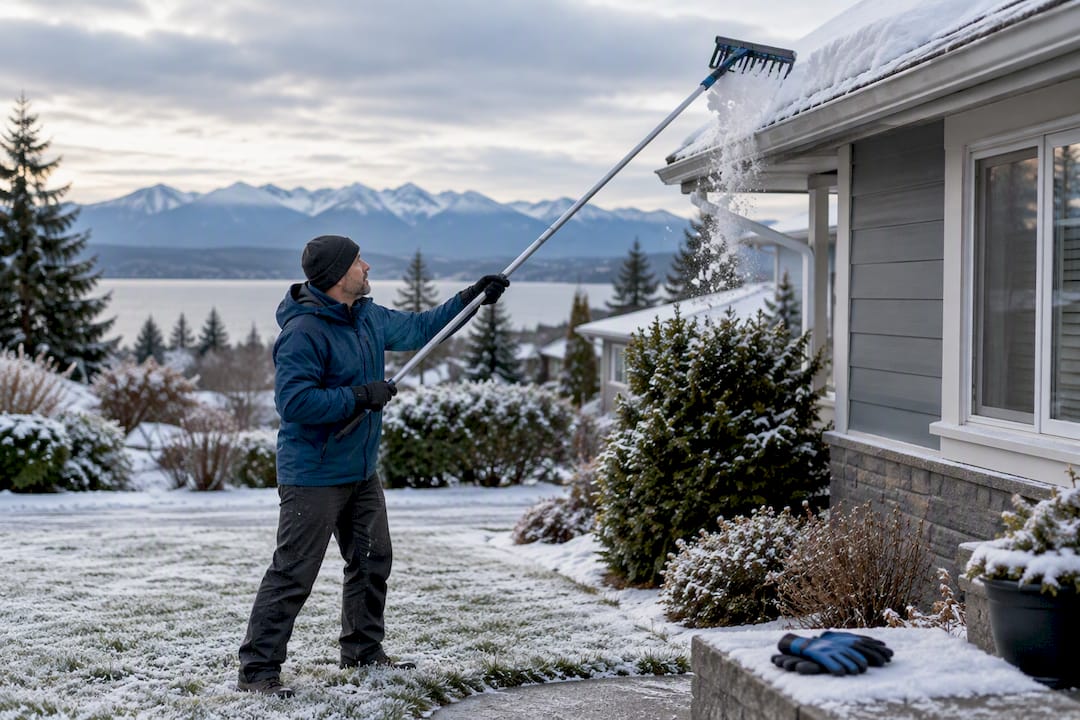
Never chip at ice with a hammer, screwdriver, or any metal tool. It cracks seams and dents gutters faster than the ice itself damages them. And never step onto an icy roof to deal with a dam. That's the single most common cause of winter roofing injuries, and it's entirely avoidable.
Pro Tip: Keep a second, cheaper roof rake head on hand. If you catch it on a nail or shingle edge, you'll be glad you didn't have to stop mid-storm to buy a new one.
When should you clean your gutters, and how often should you recheck them?
Late fall, after most leaves have dropped but before the first hard freeze, is the ideal window for your main winter gutter maintenance clean. A second check in late spring, once the thaw is complete, catches anything winter left behind.
Homes surrounded by heavy tree cover need more frequent attention. Properties with significant tree coverage often need cleaning three to four times a year rather than the standard twice.
Between full cleans, a quick seasonal gutter inspection keeps small problems from becoming big ones:
- Recheck after any storm with sustained high winds, since branches and shingle grit land in gutters fast.
- Recheck after heavy snowfall, especially wet, dense snow that piles high on the eaves.
- Walk the perimeter every few weeks in winter and look up for icicles, sagging sections, or overflow staining on the fascia.
- If you spot a problem, deal with it that week. Waiting for spring almost always means a bigger repair bill.
How do you recognize, prevent, and safely remove ice dams?
Ice dams form when heat escaping through your attic melts snow on the upper roof, and that meltwater refreezes the moment it reaches the colder eaves. A blocked gutter makes it worse, because the water has nowhere to go once it reaches the edge.
Prevention beats removal every time, and it starts with the same clean gutters you'd do for any winter gutter maintenance routine. Beyond that:
- Keep gutters and downspouts completely clear heading into the cold season, since even a partial clog gives ice a place to start building.
- Address attic heat loss. If ice dams keep coming back even with clean gutters, the real cause is usually insulation or air sealing, not the gutters themselves. Warm air leaking into the attic is what melts the snow in the first place.
- Install heat cables in chronic trouble spots. Self-regulating heat cables keep a channel of open water running through the gutter and downspout during long cold stretches, which stops the dam from sealing shut.
- Use a roof rake after every heavy snowfall to pull weight off the eaves before it has a chance to melt and refreeze.
- If a dam has already formed, calcium chloride socks laid across the ice can create a channel for water to escape. Never chip, hammer, or pry at the ice, and never send anyone onto the roof to do it by hand.
Reality check: homeowners chip away at ice dams with the tools nearest to hand, which is exactly how gutters get bent, shingles get cracked, and roof leaks start in spots that were never a problem before. If a dam is large enough that a hose or calcium chloride sock isn't cutting it, that's the point to call in a professional with steam equipment rather than escalate the DIY approach.
Which gutter guards, cables, and upgrades actually help in winter?
Not every upgrade suits every climate, so match the fix to the actual problem your gutters have.
- Micro-mesh guards are generally the strongest winter performer because they block fine debris like pine needles and roof grit that clog standard screens. Cheaper mesh or reverse-curve designs can actually make winter performance worse if they're the wrong fit for your roof pitch.
- Covering your gutters with any guard system cuts down on clogs and overflow, but only when the guard is chosen and installed correctly. A poorly matched guard just shifts the debris problem onto your roof edge instead of solving it.
- Self-regulating heat cables adjust their output with the temperature, which uses less power and lasts longer than fixed-resistance cables left running for weeks at a time. Run them in a zigzag through the gutter and continue them down into the downspout, since that's where refreezing usually starts.
- Downspout upsizing helps homes that deal with heavy slush. Moving from a standard 2 by 3 inch downspout to a 3 by 4 inch size reduces clogging when snowmelt is thick and slow moving.
- Attic insulation and ventilation fix the root cause behind repeat ice damming. If you've upgraded guards and cables and dams still form, the leak is in your building envelope, not your gutter system. A balanced approach to attic airflow often resolves the temperature imbalance that drives the melt-refreeze cycle in the first place.
Alu-Rex double-layered aluminum guards, the system Islandmossbusters installs, fall into the micro-mesh category that performs well against needles and grit through a coastal winter.
When should you hire a professional for winter gutter work?
Some jobs are worth doing yourself. Others aren't worth the risk. Call a professional if any of these apply to your home:
- Your home is two storeys or has a steep roof pitch where a ladder alone won't give safe, stable access.
- Gutters are sagging, pulling away from the fascia, or showing cracked seams.
- You've had ice dams in the same spot more than once, even after clearing debris.
- Sections of gutter are hard to reach safely from any ladder position on your property.
A reputable winter prep visit from an insured crew typically includes a full debris clean, hanger and seam repairs, guard or heat cable installation where needed, and a straightforward read on whether your attic ventilation is contributing to ice problems.
Before booking anyone, ask for proof of insurance, ask for references from recent winter jobs, and ask exactly what de-icing method they use if you already have a dam. A vague answer on any of those three is a red flag.
Pro Tip: Ask whether the crew inspects gutter slope with a level, not just by eye. A gutter that looks straight can still be pitched wrong by enough to leave standing water that turns to ice overnight.
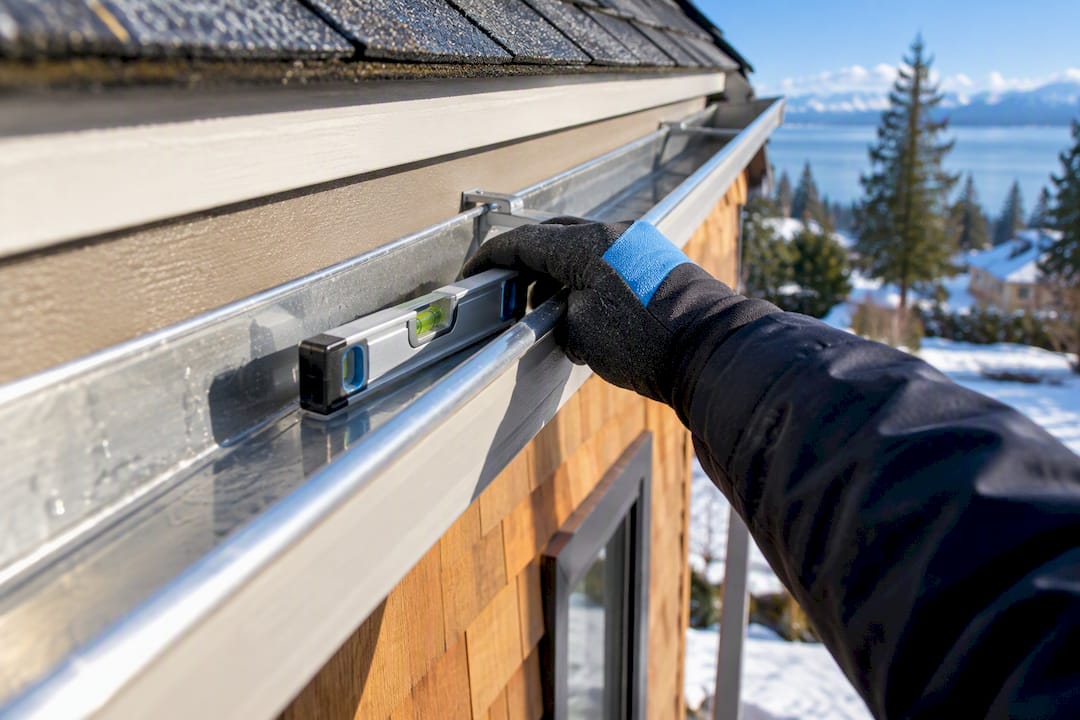
The real advantage of hiring out isn't just convenience. It's avoiding the ladder injuries and rookie mistakes, like standing on an icy roof edge or prying at ice with a screwdriver, that turn a maintenance job into an insurance claim.
Islandmossbusters' approach to winter-ready gutters
The company is a family-run, fully insured crew serving the Comox Valley and wider Vancouver Island, using eco-friendly cleaning solutions on every job. We treat gutter cleaning as part of the same winter picture as your roof: clogged gutters and mossy shingles both trap water against your home. Our roof soft washing and moss removal work, backed by a two to two-and-a-half year moss return guarantee, pairs naturally with gutter clearing and Alu-Rex guard installation, all scheduled by insured, safety-first crews before the wet season sets in.
— Island
Book professional gutter cleaning or guard installation before the freeze
Doing this yourself is doable for a lot of homes, but it eats a Saturday, and a missed slope problem or a skipped downspout check can cost you a lot more than the time you saved. A local company offers Comox Valley homeowners a faster, done-right alternative to the DIY ladder routine: insured crews handle the full winter gutter maintenance job, from debris clearing to hanger repairs, in one visit, using eco-friendly cleaning products.

Our gutter cleaning service covers the same debris removal, downspout flushing, and slope check outlined above, done by a team that already knows this coastline's leaf and needle load. If your home has had repeat clogging or ice trouble, ask about gutter guard installation using the Alu-Rex double-layered aluminum system, which handles fine debris well through a wet coastal winter. And if moss on the roof is feeding water into your gutters faster than they can drain, our roof cleaning and moss removal service, backed by our multi-year moss return guarantee, tackles that at the source.
Request a quote through our service pages, or call 250 650 8123 to get on the schedule before the next cold front moves in.
Sources
- 7 essential gutter tasks to protect your home this winter | Better Homes & Gardens
- How to clean gutters | The Home Depot
- How to heat gutters to prevent ice damage | House Digest
- Should you cover your gutters in winter? | Martha Stewart
FAQ
What month is best to clean gutters?
Late fall, once most leaves have come down but before the first hard freeze, is the best window for your main clean. A second check in late spring after the thaw catches anything the winter left behind, and homes with heavy tree cover often need cleaning three to four times a year.
Should you remove downspouts in winter?
No, downspouts should stay attached and clear, not removed. Pulling them off leaves water with nowhere to go, which just relocates the flooding risk to your foundation instead of preventing it.
Is there a way to clean gutters without a ladder?
Yes. A roof rake with an extension pole clears snow and light debris from the ground, and a garden hose with a spray nozzle can flush shorter runs from a stepladder or an upper window in some homes. For a full clean on a two-storey or steep-pitched roof, a professional gutter cleaning visit is the safer route.
When should you clean gutters in the fall?
Aim for the point after roughly 90% of leaves have dropped, but before overnight temperatures start dipping below freezing regularly. Cleaning too early means doing it again once the last leaves fall, and waiting too long risks a freeze locking debris into place.
How much does gutter cleaning cost?
Pricing depends on your home's size, roofline, and access, so it's not something we quote as a flat rate. You can request a quote directly through the Islandmossbusters gutter cleaning page.