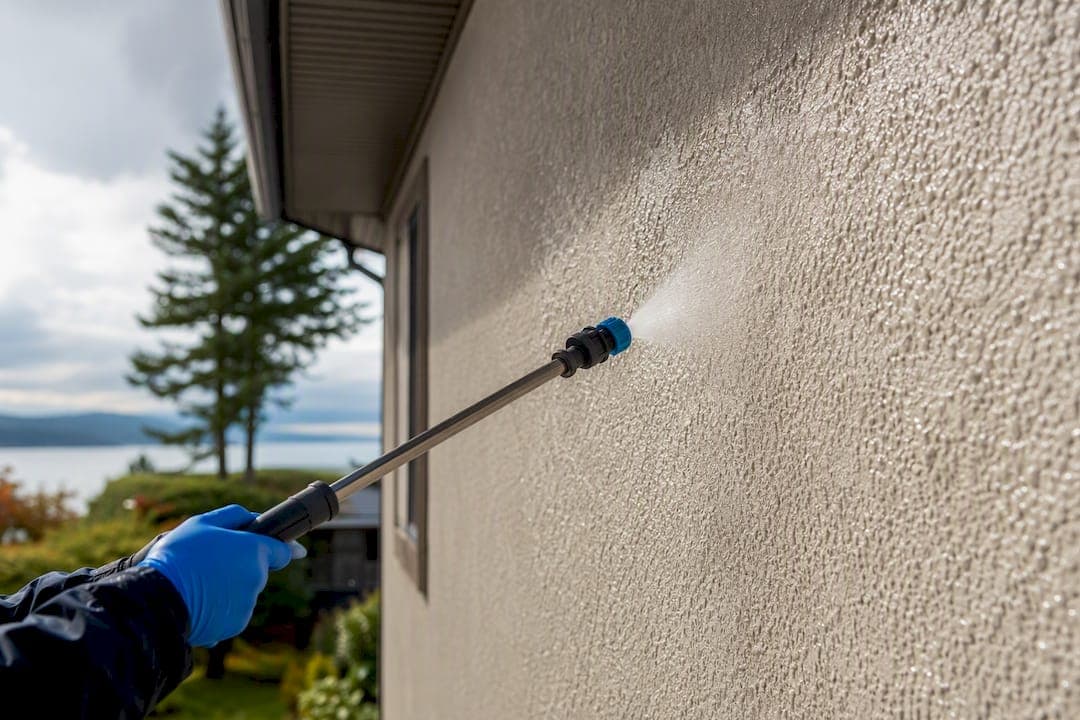
Soft washing is the safest way to clean sound stucco and EIFS, and it works when you get three things right: inspect first, use a low-pressure chemical application with a conservative mix, then rinse gently. Skip the pressure washer. If your stucco has open cracks, delamination, or moisture damage, fix that before any cleaning starts.
TL;DR:
- Most homes should be soft washed every 12 to 24 months, with more frequent cleanings needed for shaded, humid, or heavily foliaged walls.
- Chemical mixes for stucco must be kept at or below 1% active concentration, with EIFS requiring around 0.5%, to prevent surface damage.
- Applying low-pressure (under 60 PSI) and maintaining a 5 to 10-minute dwell time are essential to safely clean stucco without risking etching or water intrusion.
- Contractors should inspect for cracks, moisture issues, and structural damage before cleaning, and should always perform a test patch to confirm substrate compatibility.
- Properly contained runoff and neutralization are critical, especially on tinted or painted finishes, to prevent environmental contamination and color damage.
Table of Contents
- What is stucco soft washing and why is it safer than pressure washing?
- When should you soft wash, and when should you hold off?
- How do you soft wash stucco step by step?
- What solution strength and dwell time work best?
- What mistakes cause the most stucco damage, and how do you vet a contractor?
- How often should you soft wash stucco, and what does it cost?
- A practitioner's view on what actually keeps stucco safe
- Book a professional stucco soft wash with Islandmossbusters
- Sources
- FAQ
What is stucco soft washing and why is it safer than pressure washing?
Soft washing combines a chemical biocide and a surfactant applied at low pressure, letting the solution do the work instead of mechanical force. The chemistry breaks down algae, mildew, and moss on contact, while the surfactant helps it cling to a vertical wall long enough to work.
High-pressure washing does the opposite. Pushing water at high PSI can etch the stucco's texture, dislodge aggregate, and drive water straight into the wall assembly behind it. Canadian stucco maintenance guidance points to 500 PSI as the threshold where damage risk climbs sharply on both traditional and synthetic finishes.
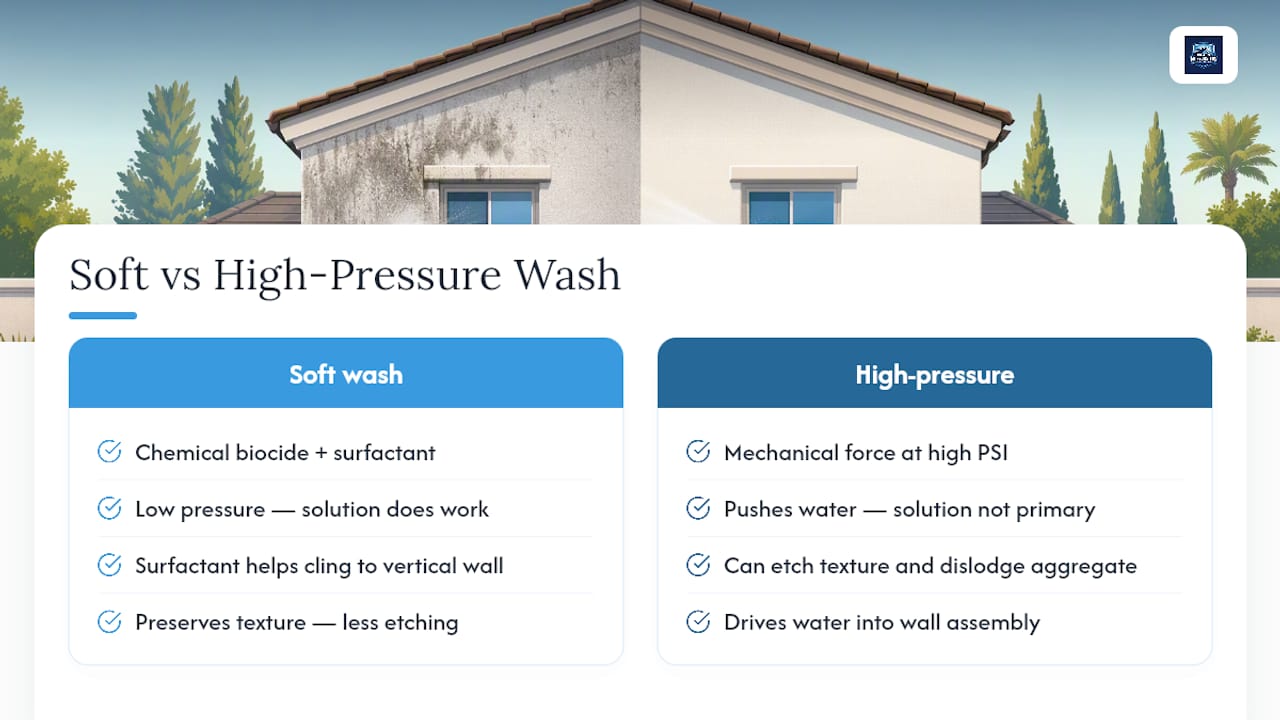
EIFS, or synthetic stucco, is especially exposed here. It's a thin polymer finish over rigid foam insulation, and once water gets behind that finish, it has nowhere to go and no easy way to dry out. Painted or thin-coat finishes carry similar risk, since pressure can strip pigment along with grime.
When should you soft wash, and when should you hold off?
Not every stucco wall is ready for a soft wash the day you notice green streaks or black mildew spots. A quick walk-around before you book anything, or before you mix a bucket yourself, tells you whether cleaning is even the right first move.
Look for these red flags before scheduling any wash:
- Cracks wider than 1/16 inch, which can let cleaning solution and rinse water into the wall cavity
- Delaminated or bubbling finish, a sign the stucco has already separated from what's underneath
- Compromised flashing around windows, doors, or roof lines
- Failing or cracked sealant joints
- Any visible staining that suggests existing moisture intrusion
If you spot any of these, repair comes first. Washing over an open defect just pushes water and chemical into places you don't want either. It's also worth holding off if you're seeing heavy efflorescence (that chalky white mineral bloom), since cleaning won't fix the underlying moisture issue causing it, or if the stucco was recently painted with an oil-based product or poured within the last 28 to 60 days. New stucco needs to cure fully before it can handle a chemical wash.
How do you soft wash stucco step by step?
This is the sequence a careful DIYer can follow, and it's also the exact process to expect from a contractor who knows what they're doing. If a quote skips half these steps, that's worth asking about before you sign anything.
- Pick your weather window. No direct sun on the wall (it flash-dries the solution before it can work) and no rain is forecast for at least 24 hours.
- Protect the surroundings. Cover or thoroughly wet down plants, shut vents, and tape off anything you don't want touched by overspray. A quick walk to check nearby windows and trim for gaps is worth the five minutes.
- Pre-wet the base of the wall and adjacent hardscape so chemical doesn't concentrate and burn into dry, porous surfaces.
- Apply the chemical at low pressure, ideally under 60 PSI, using a pump sprayer or a purpose-built soft-wash rig. Never use a standard high-pressure washer for this step, even on the lowest setting.
- Work top to bottom in even, overlapping passes, keeping the surface visibly wet across the whole treatment area. Follow the product's own instructions for coverage and mixing.
- Let it dwell, typically 5 to 10 minutes depending on the product and the level of growth. Don't let it dry on the wall.
- Agitate gently only where needed, using a soft nylon brush on stubborn spots, never a stiff-bristle brush or scraper.
- Rinse at low pressure, either with a garden hose or a soft-wash wand on its lowest setting, flushing top to bottom.
- Apply a neutralizer if the finish is painted or tinted, to stop any lingering chemical from affecting the colour.
- Inspect the dried wall. If a stain persists, re-treat conservatively after 48 hours rather than reaching for more pressure or a stronger mix.
Pro Tip: If a section still looks patchy after a second treatment, the problem usually isn't dwell time or concentration. It's often deeper staining from a leak or persistent shade, and that's a repair conversation, not a cleaning one.
What solution strength and dwell time work best?
Concentration matters more on stucco than on most siding, because the surface is porous and the finish (especially on EIFS) can react badly to a mix that's too strong. Getting this wrong is one of the most common ways well-meaning DIYers damage a wall they were only trying to clean.
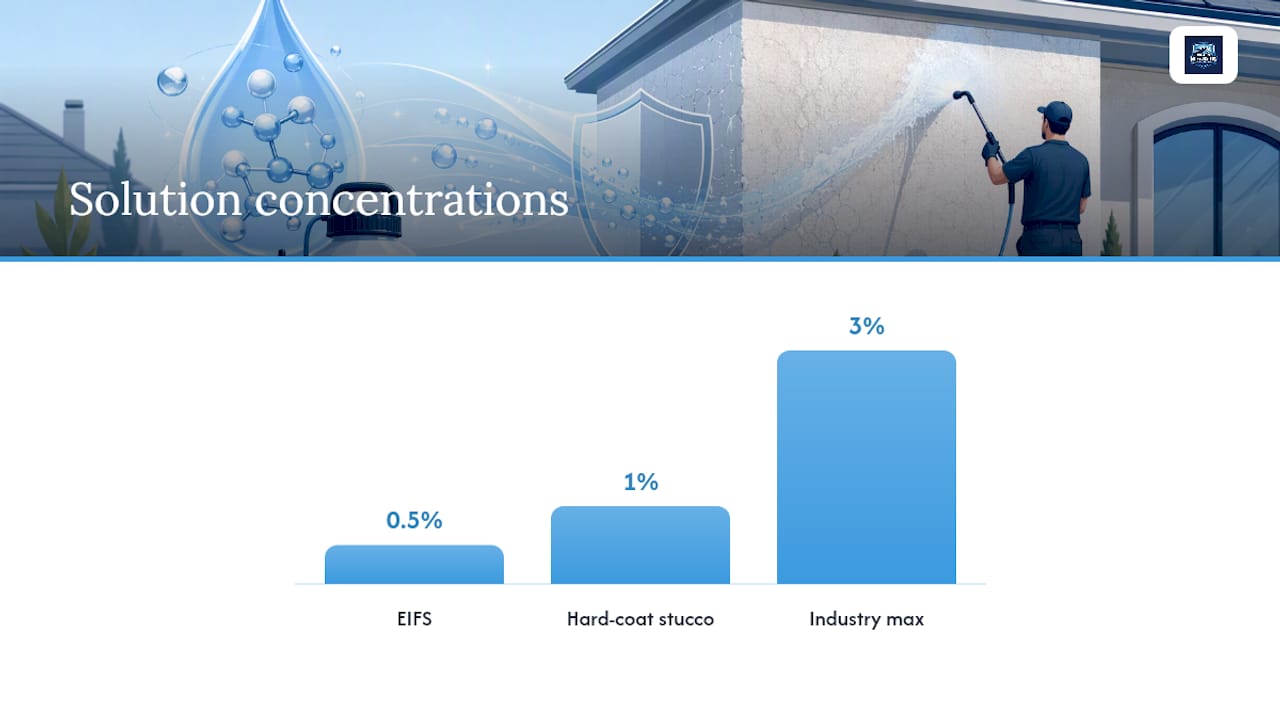
Sodium hypochlorite is the most common active ingredient, and industry ranges run 0.5% to 3% active depending on soil load and substrate.
- For most hard-coat stucco, staying at or under 1% active concentration is a reasonable ceiling for routine cleaning.
- For EIFS, drop to around 0.5%. Operators who specialise in synthetic stucco generally favour the lower end, and many prefer oxygen-based or enzymatic cleaners entirely when colourfastness or a coating system is a concern.
- Dwell time typically runs 5 to 10 minutes for detergents and mildewcides, extending to 10 to 20 minutes for diluted bleach on heavy growth. The surface must stay wet the entire time.
- Test any mix on a small, inconspicuous patch first, per manufacturer application guidance, and wait to see how the finish reacts before treating the whole wall.
What mistakes cause the most stucco damage, and how do you vet a contractor?
"Just turn the pressure down" is the mistake behind a lot of ruined stucco jobs. Dialing back PSI on a pressure washer without switching to a proper low-pressure chemical method still risks etching, and it doesn't fix the real problem, which is using the wrong tool for the surface.
Other frequent failure points: mixing a solution too strong for painted or tinted finishes, letting chemical dwell too long and dry on the wall, and ignoring where the runoff actually goes. Many municipalities restrict cleaning chemicals from entering storm drains, so containment and plant protection aren't optional extras.
Before hiring anyone, ask these questions:
- Do you inspect for cracks and moisture damage before quoting the job?
- Have you worked on EIFS specifically, and does your mix change for it?
- Are you insured, and what happens if something goes wrong?
- Do you run a test patch before treating the full wall?
- Do you neutralize painted or tinted surfaces after rinsing?
A contractor who can't answer these clearly probably hasn't thought through the substrate at all.
How often should you soft wash stucco, and what does it cost?
Most homes do well with a professional soft wash every 12 to 24 months, though shaded north-facing walls, coastal humidity, and nearby trees can push that closer to once a year.
Cost varies with square footage, growth severity, and substrate. EIFS jobs typically cost more because of the lower-concentration mixes, extra masking, and slower, more careful application they require. Full containment for runoff and plant protection on a larger property adds to the price too, but it's the difference between a clean wall and a wall with a drainage complaint attached to it.
A practitioner's view on what actually keeps stucco safe
The PSI number gets all the attention, but it's not really the deciding factor. What separates a safe stucco wash from a damaging one is the operator's judgment: identifying the substrate correctly, mixing conservatively, controlling dwell time, and containing runoff properly. A careful crew running a slightly higher PSI with the right technique can do less damage than a sloppy one running "low pressure" with an over-strength mix and no test patch.
Islandmossbusters runs two crews across the Comox Valley using Canadian-made eco-conscious solutions, and the same discipline that backs our roof soft washing and moss removal guarantee applies to stucco. That means treating EIFS with lower concentrations by default, testing before committing to a full wall, and protecting the plants and drainage around every job we run.
— Island
Book a professional stucco soft wash with Islandmossbusters
Hiring a pro removes the guesswork around concentration, dwell time, and substrate handling that trips up most DIY attempts, especially on interior door inspection and replacement as part of comprehensive home maintenance. When Islandmossbusters quotes a stucco soft wash, the estimate covers a full pre-inspection, EIFS-specific checks where relevant, containment for runoff and nearby plants, and neutralization on painted or tinted finishes.

A family-run, fully insured crew serves Comox, Courtenay, and the wider Comox Valley, with service reaching Cumberland, Campbell River, Merville, Parksville, and Qualicum Beach. If your stucco is showing green streaks, black mildew, or general grime, our house washing service is the direct next step. Call 250 650 8123 or book online to get an estimate scheduled before the wet coastal season pushes growth further into the finish.
Sources
- Proper cleaning techniques for maintaining EIFS in Ontario
- Softwash for stucco surfaces
- Stucco Cleaner product data sheet — Omega Products
FAQ
What is the best way to soft wash stucco?
The best method combines pre-inspection, a conservative chemical mix applied under roughly 60 PSI, a 5 to 10 minute dwell, and a gentle low-pressure rinse from top to bottom.
Is it okay to pressure wash stucco?
No. High-pressure washing above roughly 500 PSI can etch the finish, dislodge aggregate, and force water into the wall assembly, which is why soft washing is the recommended approach for both hard-coat stucco and EIFS.
How much PSI should you use to wash stucco?
Chemical application should stay under about 60 PSI, and the rinse step should use low-pressure flow from a garden hose or a soft-wash wand on its lowest setting rather than a standard pressure washer.
How do you make exterior stucco look smooth and clean again?
Consistent cleaning results come from an even chemical application, full dwell time without letting the surface dry, and a thorough top-to-bottom rinse. Uneven or patchy results usually mean the mix dried out in spots or coverage was inconsistent, not that the wall needs more pressure.