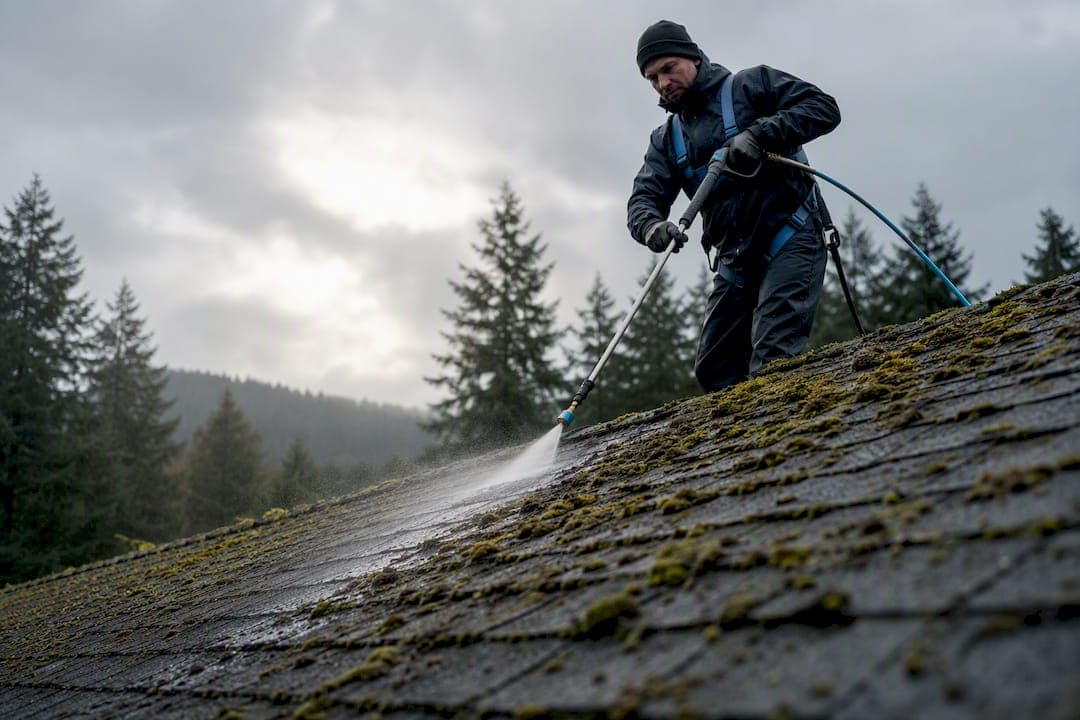
Soft washing is the safest, manufacturer-approved way to remove algae, moss, and lichen from most residential roofs. It uses a low-pressure biocidal solution to kill growth at the root instead of blasting it off, which protects your shingles and your warranty. Most homeowners can rely on this method for routine maintenance, but steep roofs, heavy moss buildup, or fragile shingles call for a trained, insured professional.
TL;DR:
- Soft washing uses nozzle pressures below 500 PSI and a 3% to 6% chlorine solution to kill algae, moss, and lichen without damaging shingles or voiding warranties.
- Proper soft wash involves pre-inspection, careful chemical mixing, top-to-bottom application, and a no-rinse policy that allows residues to weather off naturally.
- The process is safest when performed by insured professionals with experience in matching chemistry to specific roof materials, especially on steep or multi-storey roofs.
- Costs vary based on roof size, pitch, and growth severity, typically ranging from a few hundred dollars to over $850 for heavy infestations, with results lasting 2 to 5 years depending on climate and maintenance.
- Homeowners should consider professional services for heavy moss or fragile shingles, as improper DIY attempts risk damage, warranty loss, and environmental harm from unprotected chemicals.
Table of Contents
- What roof soft washing is and why it matters
- What does the soft wash process actually look like?
- How risky is soft washing for plants, paint, and different roof materials?
- When should you DIY vs. hire a professional?
- What does roof soft washing cost, and how long does it last?
- How Island Moss Busters puts this process into practice
- Why the "just pressure wash it" advice keeps homeowners in trouble
- If you'd rather leave it to a trusted local crew
- Sources
What roof soft washing is and why it matters
Roof soft washing means applying a low-pressure biocidal solution to your roof to kill algae, moss, and lichen at the root, rather than blasting them off with force. Pressure washing scrapes debris away mechanically, which can strip protective granules right off your shingles. Soft washing skips that mechanical damage entirely by relying on chemistry instead of force.
The numbers matter here. Soft washing uses nozzle pressures well under standard pressure-washer ranges, often below 100 to 500 PSI, paired with working solutions in the 3% to 6% active chlorine range for asphalt shingles. That combination kills growth without disturbing the shingle surface.
This isn't a fringe technique. Industry technical resources note that ARMA and major shingle manufacturers recommend low-pressure chemical cleaning over high-pressure washing specifically to protect asphalt shingles and preserve manufacturer warranties.
The usual culprits on a coastal roof include:
- Gloeocapsa magma, the blue-green algae responsible for those dark streaks running down north-facing slopes
- Moss, which lifts shingle edges and traps moisture underneath, accelerating decay
- Lichen, a tougher, root-anchored growth that can bite into the shingle surface itself
What does the soft wash process actually look like?
A proper soft wash job follows a consistent sequence, whether it is a small bungalow roof or a large multi-peak home. Here is what to expect from start to finish.
- Pre-inspection. A technician checks the roof's age, looks for granule loss, soft spots, and gutter debris, and takes photos before touching anything. Documenting pre-existing conditions protects both the homeowner and the crew if a dispute comes up later.
- Equipment setup. Most professionals now run 12V electric soft wash pumps rather than older gas rigs, because electric systems deliver lower overspray and easier handling. A proportioner meters the mix, and nozzle selection is calibrated to keep pressure low.
- Mixing. The working solution combines a surfactant with sodium hypochlorite, typically landing in the 3% to 6% range for heavy moss or algae. A test spot on an inconspicuous area confirms the mix behaves as expected before full application.
- Application. Crews work top to bottom in small sections, so runoff doesn't dry unevenly or leave streaks. Dwell time varies by growth severity, and stubborn patches often get a second, lighter pass.
- Rinse policy. Many professionals don't rinse the roof right after application. Practitioner guides describe leaving the solution to weather off naturally, which keeps the biocidal residue working longer. This means your roof may look a little rough for a week or two before it turns clean.
Pro Tip: If your roof still looks streaky three or four days after a soft wash, don't panic. Dead algae and moss often take time to weather off in rain and sun. A properly soft-washed roof usually looks noticeably cleaner within a month.
How risky is soft washing for plants, paint, and different roof materials?
Sodium hypochlorite is effective, but it isn't harmless if it's handled carelessly. It can permanently stain some painted surfaces and kill plants on contact, which is why professional crews build protection into every job, not just the roof itself.
Standard precautions include:
- Pre-wetting landscaping and shrubs near the drip line before application starts
- Covering delicate plants or moving potted ones out of the splash zone
- Testing painted trim, fascia, or siding in a hidden spot before full application
- Diluting and neutralizing runoff before it hits soil or storm drains
Material matters too. Technical guidance recommends lower active chlorine concentrations, around 2% or less, for metal roofing paired with a corrosion inhibitor, while asphalt tolerates the standard 3% to 5% range. Wood shakes and TPO membranes need even gentler mixes and a test patch first, since they're more porous and more likely to absorb chemical residue unevenly.
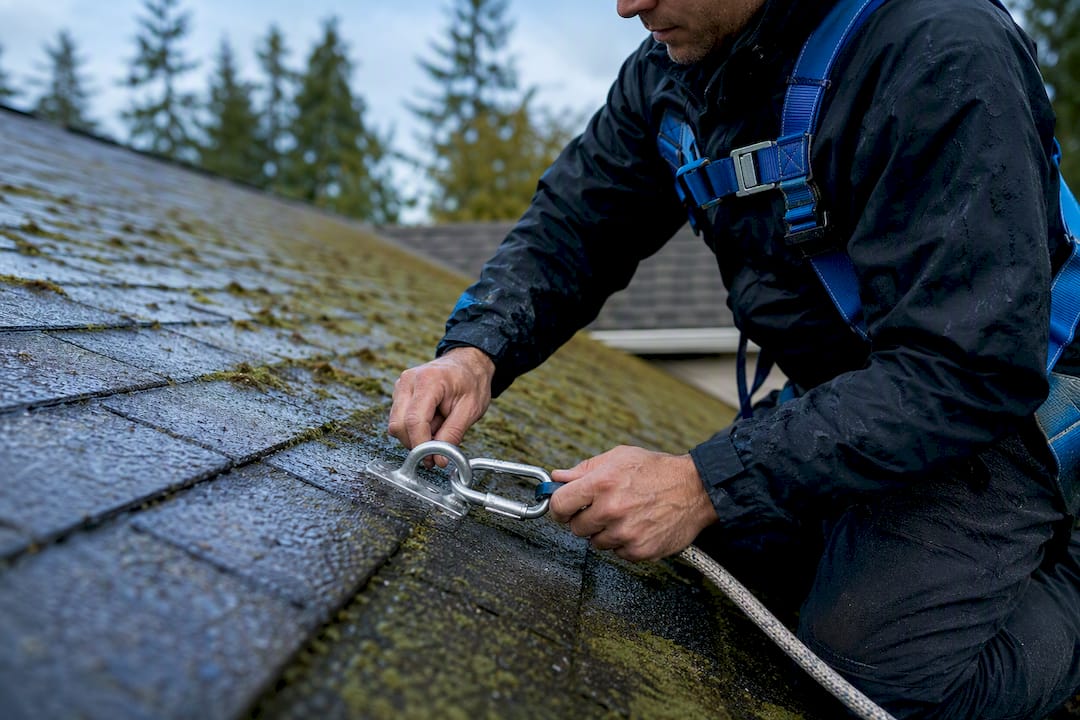
Fall safety deserves equal attention. Wet, algae-covered shingles are slippery even at low pitch, and a crew working without harnesses or insurance puts both themselves and your roof warranty at risk.
When should you DIY vs. hire a professional?
Some roofs are genuinely fine for a careful homeowner to tackle. Others aren't worth the risk. Here's how to tell which camp you're in.
- DIY works when: your roof is single storey, you have safe, stable ladder access, staining is light to moderate, and you're comfortable measuring and handling diluted bleach-based chemicals.
- Call a professional when: the roof is steep or multi-storey, moss or lichen coverage is heavy, the shingles are older or showing granule loss, or you need to protect an active manufacturer warranty.
- What a pro brings: correct chemistry matched to your specific substrate, proper containment for runoff, insured work with liability coverage, and a guarantee that covers re-treatment if moss returns early.
What does roof soft washing cost, and how long does it last?
Price depends mostly on square footage, roof pitch, and how bad the growth has gotten. A walkable single-storey roof with light algae staining costs far less to treat than a steep, heavily mossed multi-peak home that needs extra dwell time and a stronger mix.
Job time for an average residential roof usually runs one to two hours from setup to breakdown. Heavier infestations can push costs and time up substantially; one practitioner cited an $850 job for a multi-peak roof with severe moss coverage, well above a typical light-duty clean.
Results aren't permanent, and they shouldn't be sold that way. Visual clearance can take 30 to 90 days as dead moss and algae weather off, and most roofs need re-treatment somewhere in a 2 to 5 year window depending on climate and tree cover.
A few things stretch that window:
- Zinc or copper ridge strips, which release trace metal ions that inhibit regrowth over time
- Trimming overhanging branches, which cuts shade and moisture retention on the roof surface
- Keeping gutters clear, since granule buildup and standing water accelerate moss return
How Island Moss Busters puts this process into practice
Islandmossbusters is family run and fully insured, and every job runs on Canadian-made eco-friendly solutions rather than harsh generic chemicals. That matters on Vancouver Island, where damp winters and heavy tree cover push moss back onto roofs faster than in drier climates.
The crews follow the same sequence outlined above: pre-inspection with photos, a mix matched to your specific shingle type, careful application in sections, and a no-rinse policy that lets the treatment finish working. What sets the approach apart is the backend of the job. Islandmossbusters backs every roof soft wash with a two to two-and-a-half year moss return guarantee, which means if moss comes back early, the crew comes back too.
Why the "just pressure wash it" advice keeps homeowners in trouble
The most persistent bad advice about roof cleaning is that more pressure equals a cleaner roof. It doesn't. It equals a roof with fewer granules, a shortened lifespan, and possibly a voided warranty. Manufacturers didn't land on low-pressure chemical cleaning as a compromise. They landed on it because mechanical force and asphalt shingles are a bad match, full stop.
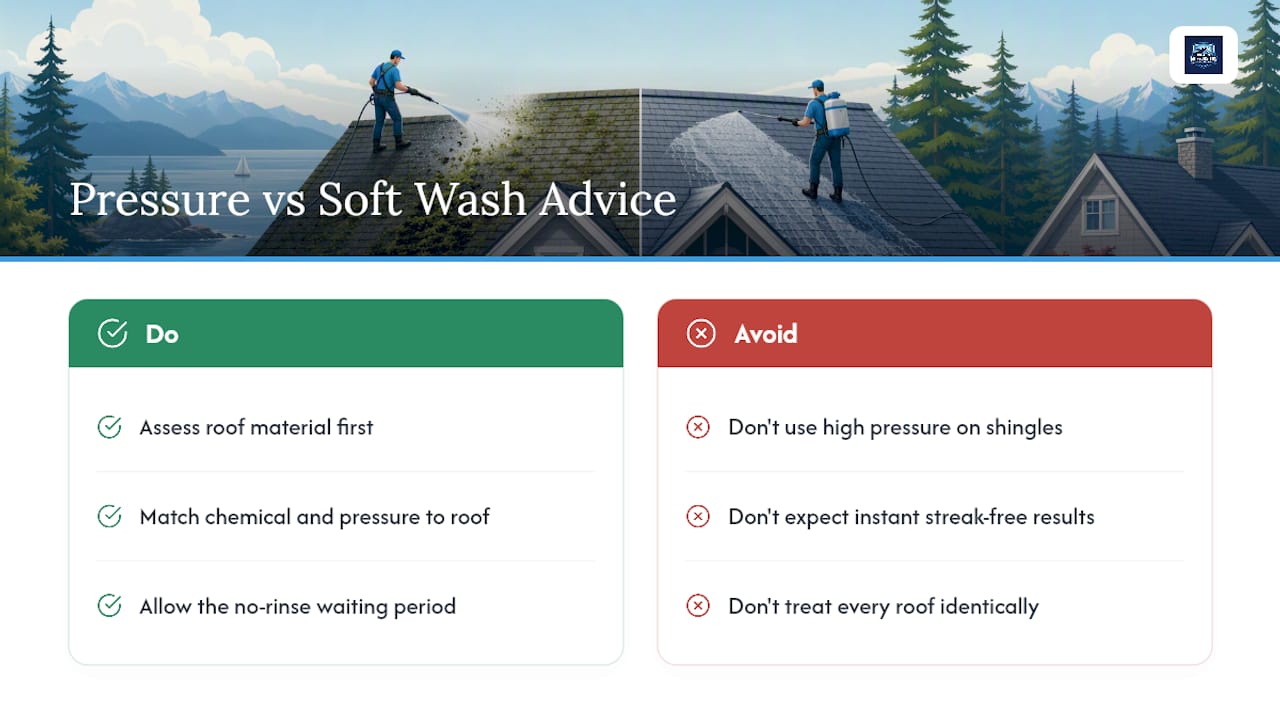
What gets underrated is the no-rinse waiting period. Homeowners often call a soft wash job a failure three days in because the roof still looks streaky, when the treatment is actually working exactly as intended. Patience matters as much as the chemistry itself.
If there's one thing to prioritize, it's matching the solution and pressure to your actual roof material rather than following a one-size-fits-all mix. A metal roof and an aging asphalt roof don't tolerate the same treatment, and a crew that treats every job identically isn't paying attention to the substrate in front of them.
— Island
If you'd rather leave it to a trusted local crew
Islandmossbusters gives you something a DIY soft wash can't: a two to two-and-a-half year moss return guarantee backed by insured, trained crews using Canadian-made eco-friendly solutions. That combination matters most on steep roofs, heavy moss jobs, or any situation where a mistake with chemical concentration could cost you a warranty claim.
Islandmossbusters runs two dedicated crews across Comox, Courtenay, and the wider Comox Valley, with service reaching Cumberland, Campbell River, Merville, Parksville, and Qualicum Beach. Every job follows the same pre-inspection, matched-mix, and no-rinse process covered above, and every roof gets treated based on its actual material rather than a generic mix. Homeowners preparing a home for sale, property managers handling strata buildings, and anyone tired of moss creeping back every couple of years get the same guarantee and the same eco-conscious approach.
Ready to get your roof assessed? Book a roof soft washing appointment online or call 250 650 8123 to get a straight answer on timing and price for your specific roof.
Sources
- Soft washing - Wikipedia
- Roof softwashing: process, safety, and best practices | National Softwash Authority
- How to soft wash a roof: full process from a 25-year veteran
Always check your shingle or roofing manufacturer's own cleaning guidance and factor in your local climate before choosing a concentration or schedule.