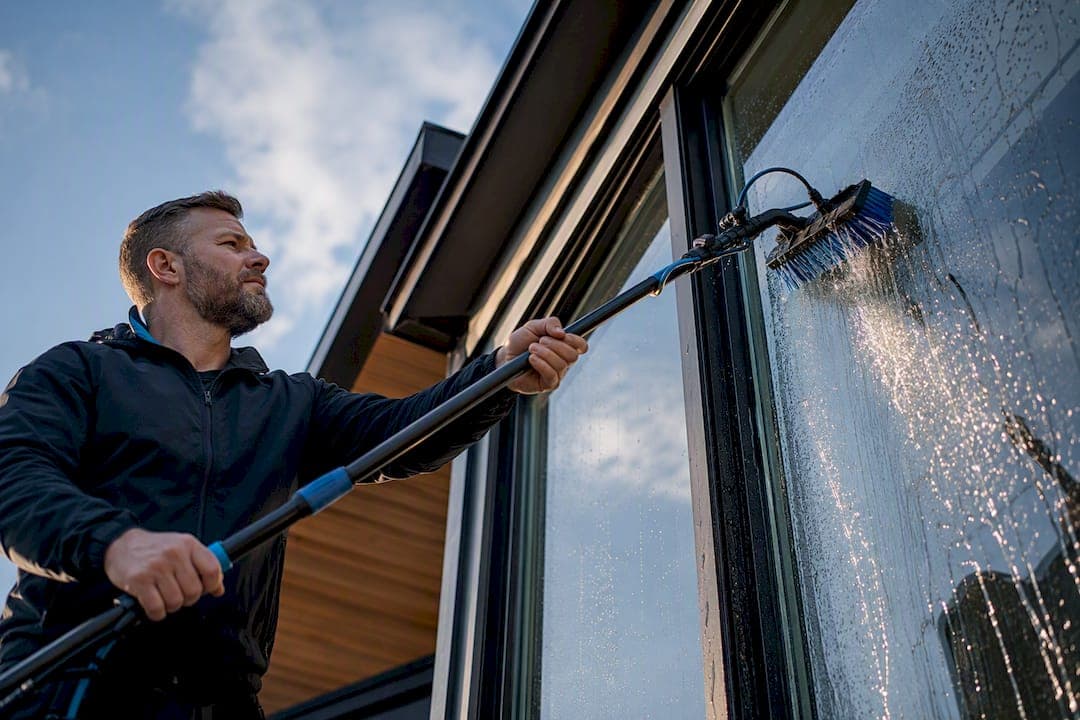
Pure water window cleaning uses water filtered to near 0 ppm TDS so windows dry spot-free without detergents, letting crews clean higher panes safely from the ground. The process relies on reverse osmosis and deionization to strip out dissolved minerals, and the right equipment and technique matter as much as the water itself. Get either wrong, and you're left with streaks anyway.
TL;DR:
- Purity of source water determines whether you need both reverse osmosis and deionization; low TDS municipal water might only require DI filtering.
- Maintaining proper TDS levels below 10 ppm is critical for streak-free, spot-free results; skipping TDS monitoring can lead to costly streaks.
- Equipment choice, especially pole reach and brush type, should be based on job height and water source TDS rather than brand preferences.
- Proper technique involves working top to bottom, cleaning frames first, rinsing in sections, and finishing with a final pass of pure water to prevent streaks.
- Pure water cleaning suits exterior glass up to five storeys, but interior windows or stained surfaces require traditional methods or prior restoration.
Table of Contents
- What is pure water window cleaning and why does it leave no residue?
- How pure water systems work: RO, DI and TDS targets
- Equipment and components: poles, brushes, tanks, pumps, hoses
- Step-by-step technique for spot-free results using a water-fed pole
- Where pure water works best and its limitations
- Maintenance, operating costs and performance monitoring
- How to choose the right system without vendor comparisons
- How Island Moss Busters uses pure water on real jobs
- What most guides get wrong about pure water cleaning
- Island Moss Busters: a practical option for hiring a pro
- Sources
- FAQ
What is pure water window cleaning and why does it leave no residue?
Regular tap water carries dissolved minerals, and those minerals are exactly what cause the spots and streaks you see on windows after they dry. Pure water window cleaning removes almost all of that mineral content before the water ever touches the glass, so there's nothing left behind to dry into a mark.
That's the whole trick. No soap, no squeegee marks, no rainbow film in the sunlight. The water itself does the work because it has been stripped down to what's called total dissolved solids, or TDS, measured in parts per million. The lower the number, the purer the water, and the cleaner the dry.
We'll explain the filtration stages next, along with the pole systems and technique that make this method work in the field rather than just in theory. If you've heard of water-fed pole window cleaning, this is the underlying system that makes it possible.
How pure water systems work: RO, DI and TDS targets
Most professional systems run water through two stages before it ever reaches the brush. The first is reverse osmosis, or RO, which forces water through a semi-permeable membrane that blocks dissolved solids and typically reduces TDS by 90 to 99 percent. The second stage is deionization, or DI, which uses resin beads to polish the water further, pulling out the last of the remaining ions.
Combined, RO and DI push TDS down close to zero. According to the National Window Cleaning Authority, operators generally treat 0 to 5 ppm as the optimal range and consider anything up to 10 ppm acceptable for spot-free drying. Above that threshold, you start seeing faint water marks as the glass dries, especially on darker frames where residue shows up more easily.
Why does ultra-pure water behave differently on glass? Once you've removed the dissolved minerals, the water becomes chemically hungry. It wants to bond with whatever is on the surface, which is what lets it lift dirt and grime without any detergent added, according to Unger USA's research on the chemistry behind pure water cleaning. That same pull is also what leaves the glass residue-free once it evaporates. There's nothing dissolved in the water to leave behind.
Not every job needs the full two-stage setup. A few things determine whether you can skip RO altogether:
- If your local municipal supply already tests low in TDS, a DI-only system can sometimes get you to that 0–10 ppm range without the extra membrane stage.
- High-TDS municipal water, common in areas with hard water, generally needs RO ahead of DI, or the resin burns through fast and costs climb.
- Well water varies enormously by property, so a quick TDS test before you invest in equipment saves guesswork later.
Knowing your source water's starting TDS is the single most useful number you can have before buying anything.
Equipment and components: poles, brushes, tanks, pumps, hoses
The pole is the most visible piece of a water-fed pole window cleaning setup, but it's really the whole chain, tank to brush, that determines your results.
Pole construction breaks into three common material choices, each with a trade-off:
- Carbon fibre poles are the lightest option, which matters a lot once you're holding one overhead for an hour, but they carry a higher price tag and need more careful handling near power lines.
- Fibreglass poles cost less and hold up to rougher daily use, though the added weight tires out your arms faster on long jobs.
- Hybrid poles, blending carbon and fibreglass sections, split the difference: lighter at the top where reach matters most, sturdier at the base where you need the strength.
Brush heads matter just as much as the pole holding them. Nylon bristles handle everyday grime well and are the standard choice for most residential and commercial glass. Boar's hair brushes are softer and better suited to older or more delicate window coatings. Hybrid brush heads blend both bristle types to balance scrubbing power with a gentler touch.
On the water side, you're looking at a DI tank (either loose resin or a swappable resin bag, with bags making changeovers far quicker), a pump to push water up the pole at working pressure, hose fittings rated for outdoor use, and a TDS meter to check your output before every job. Skip the meter and you're cleaning blind.
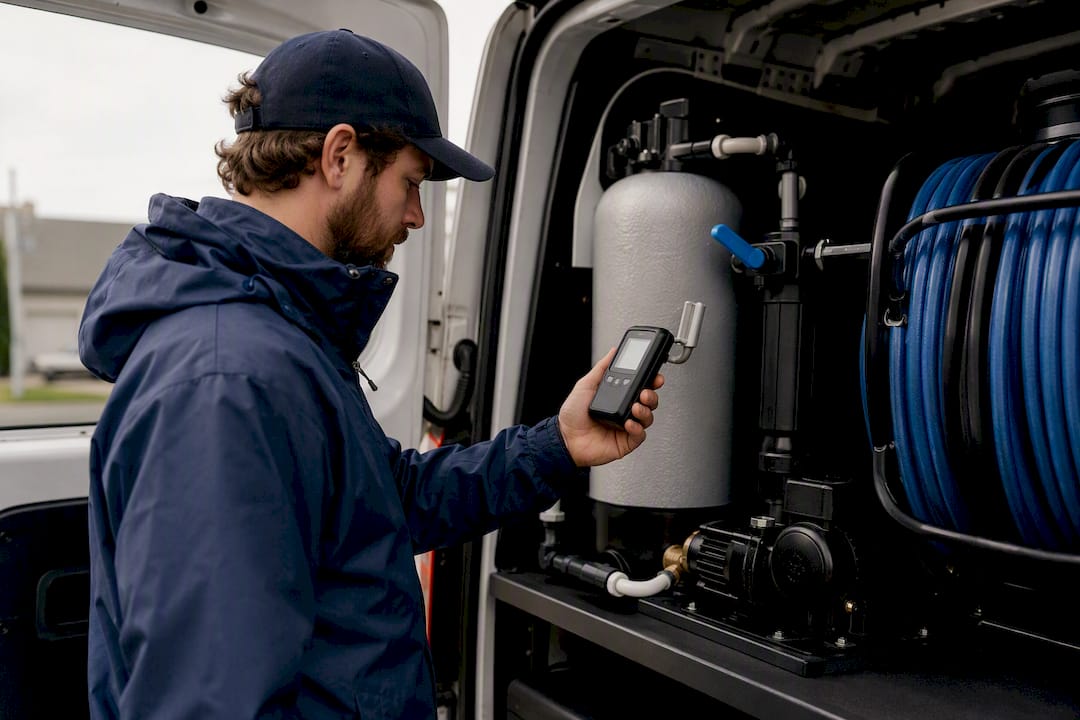
Pole reach is where the equipment translates directly into what jobs you can take on. Standard poles commonly extend up to about 65 feet, roughly 20 metres, which covers ground-floor storefronts right up through five-storey buildings without a ladder or lift in sight.
Step-by-step technique for spot-free results using a water-fed pole
Good equipment gets you halfway there. Technique closes the gap, and the order you work in matters more than most people expect.
- Start at the top of the window and work down. Scrubbing top to bottom means any loosened dirt travels down the glass and gets caught by the rinse below it, rather than dripping over a section you already cleaned.
- Scrub the frame and sill before the glass. Frames hold more grime than the pane itself, and cleaning them first stops runoff from re-contaminating glass you just finished.
- Rinse in controlled two-foot sections, moving the brush steadily rather than in wide, fast sweeps that leave gaps.
- Make the final pass with clean, unbrushed pure water. The last thing to touch the glass should always be fresh water straight from the pole tip, not water already loaded with loosened dirt from scrubbing.
- Let it air dry. No squeegee, no towel. If the water is genuinely at 0–10 ppm TDS, gravity and evaporation do the rest.
Two mistakes cause almost every streaky result: rinsing too fast, so contaminated water gets left behind, and using a brush that's picked up detergent residue or debris from an earlier job. According to JRACenstein's technique guidance, purified water needs to be the very last thing that touches the glass, which is precisely why rushing the rinse phase undoes the entire benefit of the system.
Pro Tip: If you're converting a building from detergent-based cleaning to pure water for the first time, don't expect spotless results on the first pass. Surfactant residue built up from years of soap-based cleaning typically takes two to three full cleaning cycles to fully clear, so budget for a callback rather than assuming something's wrong with your setup.
Where pure water works best and its limitations
Pure water window cleaning is built for exterior glass, and it earns its keep most clearly on ground-to-five-storey buildings, storefronts, and solar panel arrays where a detergent-free process is either preferred or required, such as healthcare and school facilities, per Unger Global's use-case guidance.
It has real limits, though:
- Interior glass isn't a good fit, since the surface can't be left wet to air-dry indoors and still needs traditional squeegee work.
- Etched or bonded hard-water staining, the kind left by years of mineral buildup, needs acid or abrasive restoration first. Pure water alone won't touch it.
- Anything above roughly five storeys generally moves into rope-access or lift territory, well past what a standard pole can reach.
Where it does apply, the safety upside is real: crews stay on the ground instead of on a ladder, and no surfactants wash into storm drains or landscaping below.
Maintenance, operating costs and performance monitoring
Running costs on a pure water system come down almost entirely to one variable: how fast your DI resin gets used up, and that depends on your source water's starting TDS.
- Test your source water TDS regularly. A cheap handheld meter tells you exactly when resin is losing capacity, rather than guessing based on how many jobs you've done.
- Use bypass or rinse valves where your setup allows it. Diverting water that doesn't need full purification, like an initial rough rinse, stretches your resin's working life.
- Keep brushes clean between jobs. A brush caked in old grime contaminates your rinse water and can force a second pass you shouldn't have needed.
- Check hose fittings and pump seals on a routine schedule; a slow leak wastes purified water you already paid to produce.
A well-sized system paired with routine TDS monitoring is, according to the National Window Cleaning Authority, the main lever operators have for controlling per-gallon costs over the life of the equipment. Skip the monitoring and you'll find out your resin is spent the expensive way, mid-job, with streaky windows to show for it.
How to choose the right system without vendor comparisons
Sizing a pure water system is mostly arithmetic, not brand comparison. Match the numbers to your actual jobs before you spend a dollar.
- Measure your highest window, then add a safety margin. If your tallest job is a four-storey building, you want a pole with meaningfully more than four storeys of reach so you're never fully extended and straining.
- Test your local source water TDS before sizing DI or RO capacity. Low-TDS municipal water might only need a DI stage; hard water almost always calls for RO ahead of it.
- Decide how portable you need to be. A backpack or cart tank suits solo residential jobs, while a van-mounted tank with higher capacity makes more sense for commercial routes running multiple jobs a day.
- Ask any supplier for a live TDS reading during a demo, and ask them to walk you through their resin-change procedure before you buy. If they can't show you both, keep looking.
That's the whole checklist. No brand loyalty required, just numbers that match your actual buildings.
How Island Moss Busters uses pure water on real jobs
Pure water earns its place on many exterior glass jobs across the Comox Valley, particularly on multi-storey homes and storefronts where ladder access is limited or the client wants a detergent-free finish. We often pair it with a full house washing visit, since a soft-washed exterior and spot-free glass tend to get booked together anyway.
A property that's had its roof, gutters, and windows all handled in one visit photographs and shows differently than one where only the windows got attention. Consistency across every exterior surface is what quality-focused homeowners and real estate listings are actually after.
We operate as a family-run, fully insured crew using eco-friendly solutions, and pure water fits naturally into that approach since it skips detergents entirely. Customers don't need to do much to prepare beyond clearing obstructions near ground-floor windows; the rest is on us.
What most guides get wrong about pure water cleaning
Most articles on this topic treat pure water systems like a magic fix: buy the pole, fill the tank, and every window comes out perfect. That's not quite honest. The research is clear that TDS discipline, not the pole itself, is what separates a spot-free finish from a streaky one, and a lot of first-time buyers skip the TDS meter entirely because it feels like an unnecessary extra cost.
It isn't. A $30 meter is the difference between knowing your resin is spent and finding out the expensive way, on a client's windows.
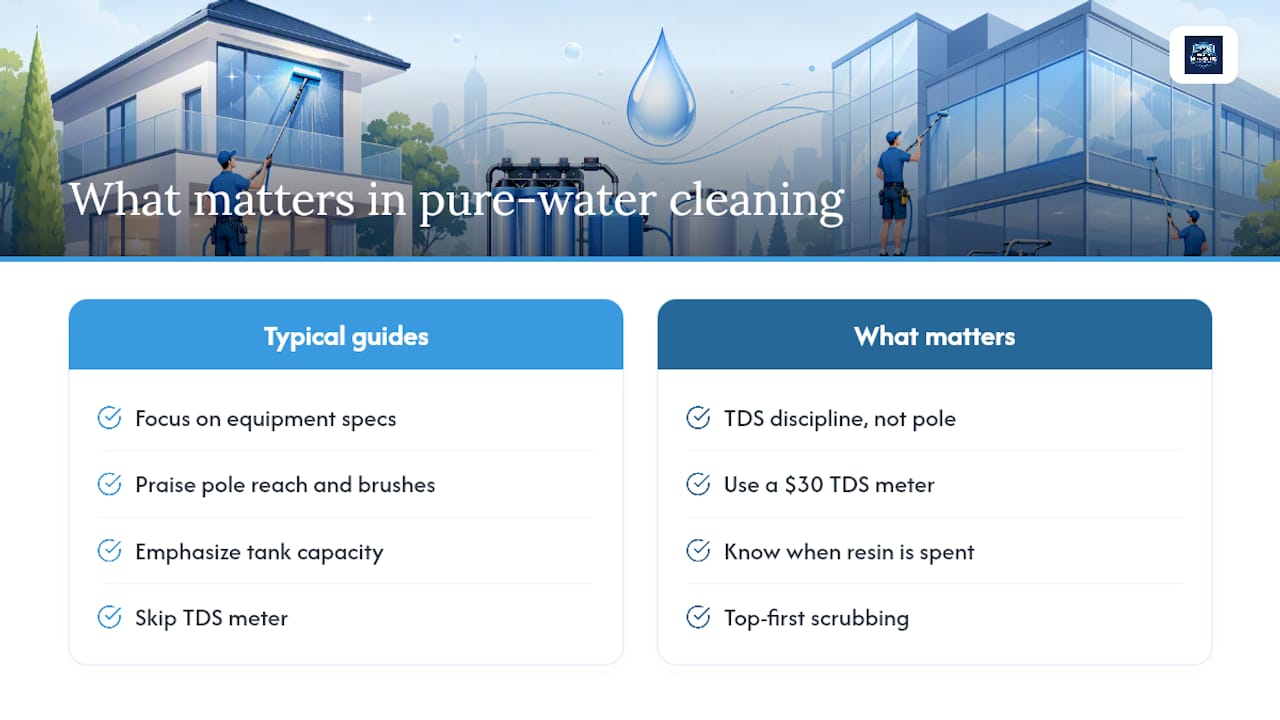
The other gap in conventional advice is technique. Guides love talking about equipment specs, pole reach, brush types, tank capacity, but they gloss over the rinse order that actually prevents streaking. Top-first scrubbing, frame before glass, and a final pass of untouched purified water aren't optional flourishes. They're the method.
If you're buying equipment, prioritize a reliable TDS reading over a slightly longer pole. If you're hiring a pro, ask what TDS range they're running. Anyone doing this properly will have an answer ready.
— Island
Island Moss Busters: a practical option for hiring a pro
If you've read this far and decided the equipment, resin monitoring, and pole handling isn't something you want to take on yourself, that's exactly the gap Island Moss Busters fills. We run pure water systems on exterior glass across the Comox Valley and surrounding areas, bringing the TDS meter, the trained crew, and an eco-friendly approach so you don't have to buy any of it.

A typical visit covers exterior window cleaning start to finish, and it's easy to pair with house washing or pressure washing for driveways and walkways if you want the whole exterior handled in one trip. We're fully insured, family-run, and we use Canadian-made eco-friendly products on every job, residential or commercial.
Ready to get your windows on the schedule before the wet season sets in? Book a window cleaning quote or call 250 650 8123 to talk through what your property needs.
Sources
- How pure water window cleaning works — Waxie
- Pure water window cleaning technology — National Window Cleaning Authority
- Window cleaning with pure water — Unger Global
- How to clean windows with a water-fed pole — JRACenstein
FAQ
Does pure water window cleaning actually work?
Yes. Water filtered to 0–10 ppm TDS dries without leaving mineral residue behind, which is what causes streaks and spots with regular tap water, according to the National Window Cleaning Authority.
How much does purified water for window cleaning cost?
Cost depends mainly on your source water's starting TDS and how much resin your DI tank uses per job; harder source water burns through resin faster and raises per-gallon cost.
What is the best pure water window cleaning system?
The right system depends on your source water TDS and the height of the buildings you're cleaning rather than any single "best" setup; size your RO/DI capacity and pole reach, commonly up to 65 feet, to match your actual jobs.
Where do window cleaners get pure water?
Professionals produce it on-site using reverse osmosis and deionization systems that treat regular tap or municipal water down to near 0 ppm TDS, rather than buying pre-purified water. Companies like Island Moss Busters carry this equipment directly on their service vehicles.