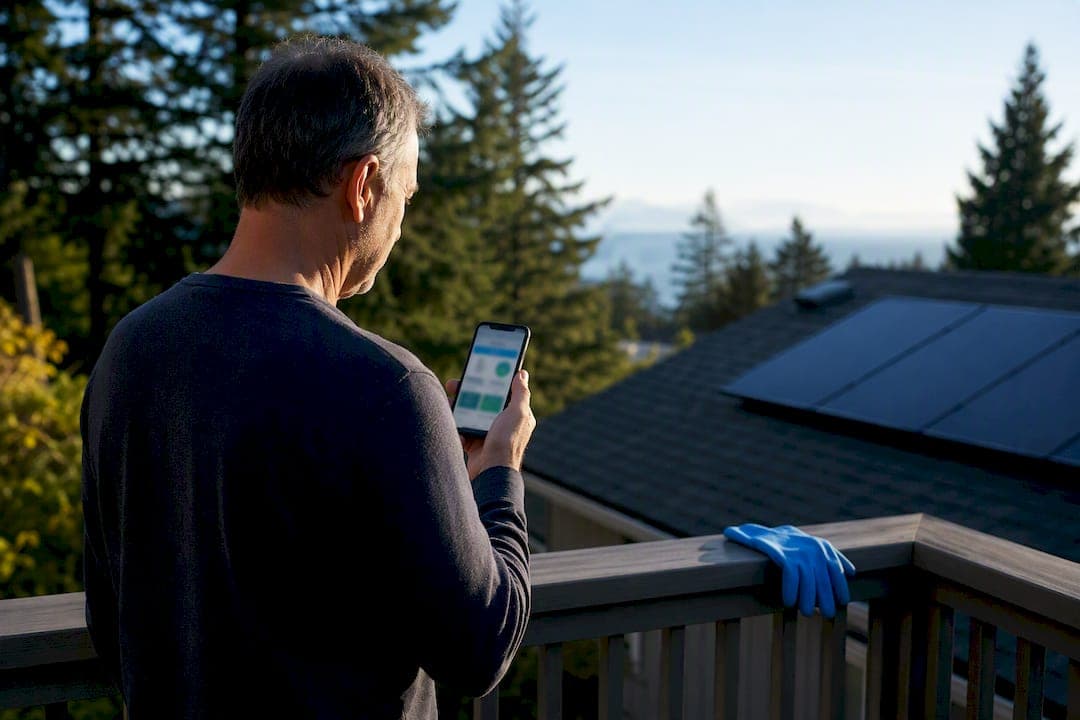
Most residential solar panels do not need regular cleaning because rain washes away loose dust and keeps output steady. The exceptions are dry or dusty climates, heavy pollen seasons, bird droppings, coastal salt spray, and flat or low-tilt panels that trap grime instead of shedding it. Before you spend a dime, check your monitoring app for a real production drop against clear-day history.
TL;DR:
- Rain generally cleans dust off panels, but sticky grime from pollen, bird droppings, or salt buildup requires manual or professional cleaning.
- Flat or low-tilt panels are more prone to grime accumulation, especially in coastal or dusty environments, making cleaning more necessary.
- Checking your monitoring app for production drops compared to historical data is the most reliable way to determine if cleaning is needed.
- DIY cleaning is safe only for accessible panels; high or steep roofs should be handled by insured professionals using gentle rinses and proper safety measures.
- Experts recommend cleaning frequency based on climate, ranging from once a year in rainy regions to quarterly in deserts or coastal areas, always guided by actual performance data.
Table of Contents
- Do solar panels need cleaning? The evidence and the exceptions to the rain rule
- How do I know if my solar panels need to be cleaned?
- DIY cleaning vs hiring a professional: what actually makes sense
- The safe way to clean solar panels yourself
- How often should you clean solar panels by climate?
- What our crews see on real Vancouver Island roofs
- What the data actually tells homeowners to do
- Getting your panels professionally cleaned without the risk
- Sources
- FAQ
Do solar panels need cleaning? The evidence and the exceptions to the rain rule
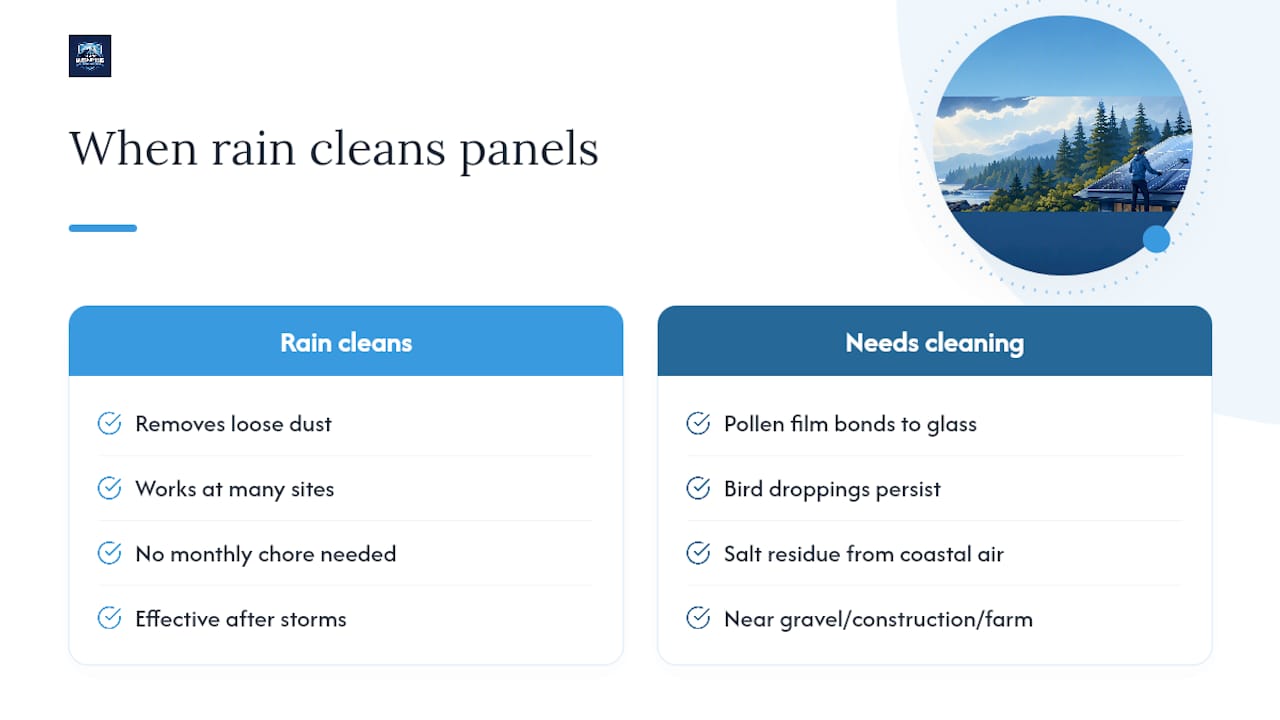
For most homeowners, rain does the job. A long-running analysis from the Sierra Club found that at many sites, routine cleaning rarely pays off because rainfall already clears the light dust that settles on panel glass. That is good news if you were picturing a monthly chore.
The exceptions are specific, not vague. Pollen film, bird droppings, and salt residue from coastal air do not rinse away the way dust does. They bond to the glass, especially in damp climates where organic grime and salt can build a stubborn layer over a season. Rain handles loose particles well but struggles with anything sticky or biologically derived.
Tilt angle matters more than most owners realize. Flat or low-tilt panels, common on some residential and commercial roofs, do not let gravity and rain do their usual work, so grime accumulates in the same low spots year after year.
Statistic Callout: Field experiments on panels under controlled and site-representative dusty conditions show that efficiency losses scale directly with dust density, and that manual cleaning delivers a moderate recovery while mechanical or automated methods recover more. That is a meaningful gap if your array sits near a gravel road, a construction site, or a farm during harvest.
Picture a coastal Vancouver Island roof after a dry August: salt haze, evergreen pollen, and the odd gull perched on a panel corner. None of that clears with a rainstorm the way a dusty summer would in a drier inland region.
How do I know if my solar panels need to be cleaned?
Your monitoring app is the most reliable tool you have, and it costs nothing to check. Compare current output against historical baselines on similarly clear, sunny days. A gradual, creeping decline over weeks usually points to soiling, not a fault.
A visual check from the ground backs that up:
- Look for streaking below the top edge, which usually means dried rain residue
- Check for a hazy, uniform film, a common pollen sign in spring
- Spot bird droppings directly, since even a few can shade an entire cell
- Snap a photo every month or so to track changes over time
Pro Tip: If output drops sharply overnight rather than gradually, that points to an electrical issue, an inverter fault, or a tripped breaker rather than dirt. Call your installer before you touch a hose.
Keep those dated photos and app screenshots. They double as useful documentation if you ever need to make a warranty claim or want a professional cleaner to see exactly what they are dealing with before quoting the job.
DIY cleaning vs hiring a professional: what actually makes sense
Ground-mounted arrays and single-storey accessible panels are reasonable DIY territory, provided you can reach them safely from a ladder or the ground. Steep roofs, multi-storey homes, and anything requiring you to walk on the roof itself are not worth the risk, no matter how confident you feel with a hose.
Manufacturer warranties are worth reading before you start. Many explicitly warn against pressure washers, abrasive brushes, and harsh chemicals, and using them can void coverage on a system that otherwise carries a decades-long guarantee.
Cost and payoff are easier to weigh than most owners assume. Consumer guides put professional cleaning for a typical residential system in the low hundreds of dollars, with production recovery in the range of 5 to 11% in cases of notable soiling, according to reporting from Popular Mechanics. If your monitoring data shows a small dip, the math may not justify the callout yet.
Call a professional when you see:
- Visible bird dropping buildup that has been sitting for weeks
- A steep or multi-storey roof with no safe ground access
- A large residential or commercial array where labour time adds up fast
- Any sign of chipped glass, loose mounting hardware, or damaged wiring
The safe way to clean solar panels yourself
If your setup is accessible and low risk, here is the sequence that protects both the panels and your warranty; for more detailed guidance on cleaning techniques and safety, see our property maintenance and pressure-washing best practices.
Before you start:
- Check your manufacturer's cleaning guidance and warranty terms first.
- Pick a cool, overcast morning or evening rather than midday heat.
- Shut down the system safely if your installer's documentation calls for it during cleaning.
During the clean: 4. Rinse loose debris with a low-pressure garden hose, never a pressure washer. 5. Wash gently with a soft brush or microfiber tool and, in hard-water areas, distilled or demineralized water to avoid mineral spotting. 6. Add a small amount of mild, eco-friendly soap only if grime persists after rinsing. 7. Rinse thoroughly to clear any residue. 8. Inspect the surface and let panels air-dry. 9. Check your monitoring app over the next clear day to confirm output recovered.
Pro Tip: Cold water on sun-warmed glass can cause thermal shock and hairline cracks over time. Clean early morning or dusk when the panel surface has cooled.
Never walk on the panels themselves, and never lean a ladder against the array frame. A pole-mounted soft brush extends your reach from the ground for most single-storey homes. Anything higher belongs to a professional with proper fall protection.
Panels are engineered to withstand genuinely severe conditions. National lab testing has shown panels surviving hailstorms that would wreck a car windshield, so a gentle rinse with a soft brush is nowhere near the panel's real tolerance. The risk in DIY cleaning is almost always technique, not the panel's fragility.
How often should you clean solar panels by climate?
| Environment | Typical cleaning frequency | Notes |
|---|---|---|
| Temperate, rainy | 0 to 1 time per year | Rain usually handles routine dust |
| Mediterranean, dry summer | 1 to 2 times per year | Check before and after dry season |
| Desert or semi-arid | Quarterly | Dust accumulates fast between rains |
| Coastal with sea spray | Quarterly | Salt film builds even without visible dust |
| Urban or industrial | 2 to 3 times per year | Airborne soot and grime settle steadily |
| Agricultural, near harvest | Seasonal, around harvest | Chaff and dust spike during harvest weeks |
| Near highways or airports | 2 to 3 times per year | Exhaust residue and particulate buildup |
| Post-wildfire | As needed after smoke events | Ash can coat panels within days |
Region-based frequency guidance from SurgePV backs these ranges, though your own monitoring data should always have the final say over a generic schedule. Flat panels need attention at the higher end of any range shown here, since low tilt traps grime that tilted arrays shed naturally.
What our crews see on real Vancouver Island roofs
A local family-run, fully insured crew uses eco-friendly cleaning solutions across the Comox Valley and Vancouver Island, backed by a moss-return guarantee on their flagship roof work. On damp coastal properties, we regularly see organic soiling and salt residue that has bonded to panel surfaces over a season, exactly the kind of grime rain does not clear on its own.
Before hiring anyone to clean your panels, ask them:
- Are you insured for roof work?
- Do you use a purified-water or low-mineral rinse?
- What method do you use to avoid scratching the glass?
- Will you provide before-and-after photos and service documentation?
A regional solar maintenance guide also recommends a licensed electrician inspection at least every two years, separate from cleaning, to catch wiring or mounting issues early.
What the data actually tells homeowners to do
The evidence points to a simple hierarchy most guides skip: check your monitoring data first, identify the soiling type second, and only then decide whether cleaning is worth the trip up a ladder. Too much advice online treats cleaning as a fixed calendar chore, like changing a furnace filter. The honest answer depends entirely on your roof's tilt, your postal code's dust and salt exposure, and what your app actually shows.
The conventional wisdom oversells frequency. Owners in mild, rainy climates are often told to clean twice a year when their own production data would show no meaningful dip at all. Meanwhile, owners with flat arrays near the coast or a gravel road get the opposite problem: generic advice that badly underestimates how fast pollen and salt film actually build up on their specific setup.
Prioritize the free step before the paid one. A five-minute app check and a walk around the yard with your phone camera will tell you more than any seasonal calendar reminder. If that check shows a real drop and your roof is anything more complex than a single-storey, straightforward access, hiring a professional is the safer call, both for your safety and your warranty.
— Island
Getting your panels professionally cleaned without the risk
Climbing a ladder to check bird droppings on a steep roof isn't worth a cracked panel or a warranty dispute. Islandmossbusters offers solar panel cleaning alongside our core roof soft washing and moss removal service, using the same eco-friendly, Canadian-made cleaning solutions across a standard visit.
Every visit includes proper safety gear, a gentle rinse approach that avoids mineral spotting and thermal shock, before-and-after inspection photos, and documentation you can keep for your own records or a future warranty claim. We coordinate with gutter cleaning too, since overflowing gutters and roof debris are a common, overlooked source of panel soiling in the Comox Valley's wet months. If your panels sit alongside siding that could use attention, our house washing service tackles both in one appointment.
If your monitoring app shows a production dip and your roof isn't safe DIY territory, call 250 650 8123 or book a quote at Islandmossbusters and we'll get your system back to full output.
Sources
- Hail? No. National labs: solar panels survive severe storm
- Is it necessary to clean solar panels? — Sierra Club
- Experimental evaluation of PV cleaning strategies under controlled and field-representative dusty conditions (2026)
- Solar Panel Cleaning Guide | SurgePV
FAQ
What happens if you don't clean your solar panels?
In most rainy climates, nothing serious happens because rain clears routine dust on its own. In dry, coastal, or pollen-heavy areas, skipping cleaning can lead to a gradual production decline as dust density increases and efficiency losses scale with it.
How do I know if my solar panels need to be cleaned?
Compare your current output against historical baselines on similarly clear days using your monitoring app, and back it up with a visual check for streaking, film, or bird droppings. A gradual decline usually points to soiling; a sudden overnight drop usually means an electrical issue instead.
What is the 20% rule for solar panels?
Definitions of this term vary by context, so it's worth confirming with your installer exactly what standard, if any, they're referencing.
What is the 33% rule for solar panels?
As with the 20% figure, no consistent "33% rule" for cleaning appears in established solar maintenance guidance. If you've seen this term elsewhere, ask the source what specific metric or standard they mean before applying it to your system.