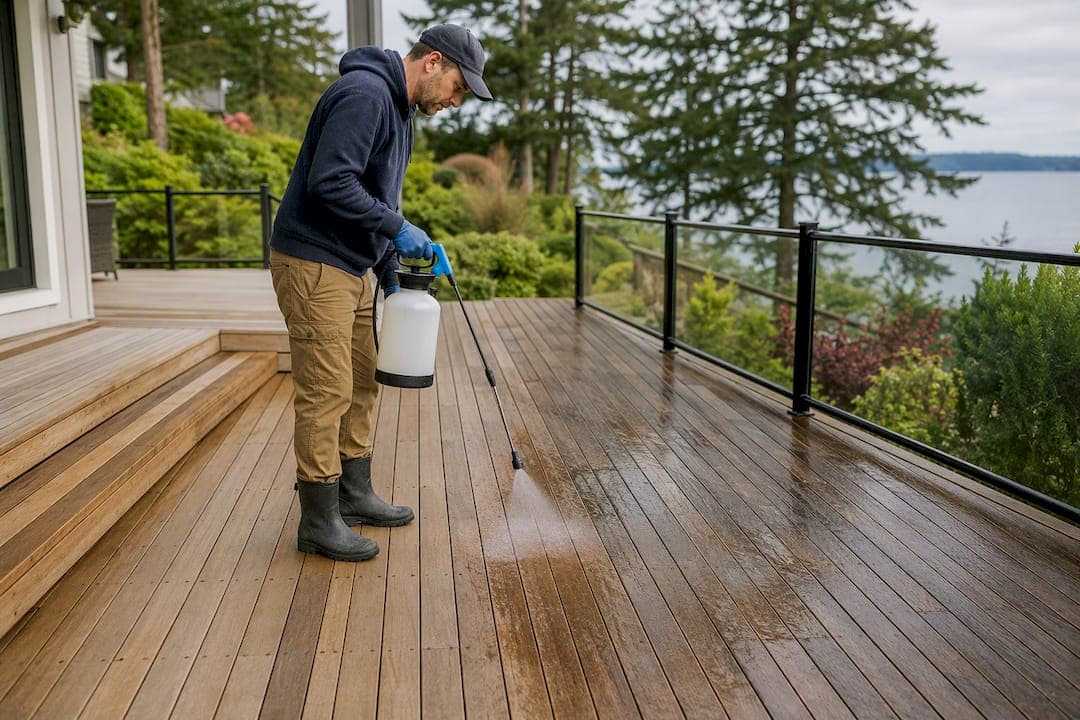
Do not use a pressure washer alone to restore a wooden deck. The safe, contractor-recommended method is a quality deck cleaner first, then a careful low-pressure rinse, because pressure washing alone often gouges wood, raises the grain, and shortens the deck's life. For homeowners who'd rather skip the risk, Island Moss Busters handles the whole job with eco-friendly cleaners and controlled rinsing.
TL;DR:
- Using a deck cleaner before rinsing reduces the risk of wood damage caused by high-pressure washing.
- Low-pressure rinsing with the correct nozzle and PSI is essential to avoid gouging or raising the wood grain.
- Older decks treated with chromated copper arsenate require extra caution, especially during cleaning or removal.
- Professional services employ eco-friendly, low-pressure techniques and proper chemical selection to protect the deck.
- The recommended cleaning sequence involves applying cleaner, allowing it to dwell, scrubbing, rinsing, and neutralizing before staining.
Table of Contents
- Deck cleaning vs pressure washing: what each one actually does
- What does improper pressure washing do to a deck?
- What PSI and nozzle settings are safe for a wood deck?
- How do you clean a deck the safe way, step by step?
- When should you hire a professional instead of DIY?
- Why we recommend cleaner first, pressure second
- Get a professional deck and exterior clean without the guesswork
- Sources
- FAQ
Deck cleaning vs pressure washing: what each one actually does
The confusion around deck cleaning vs pressure washing comes down to one thing: people treat them as competing options when they're actually two different jobs. A deck cleaner does the chemical work. A pressure washer does the rinsing. Neither replaces the other.
Oxygen-based deck cleaners and wood brighteners lift mildew, kill mould spores at the root, and strip away the grey, weathered layer of fibres sitting on top of healthy wood. That greyness isn't dirt you can blast off. It's UV-damaged wood cells, and removing them chemically is what lets stain or sealer actually soak in afterward.
A pressure washer, on the other hand, delivers water fast. It rinses. It doesn't reliably kill mildew spores, and pressure alone rarely lifts embedded stains the way a cleaner does. Restoration professionals recommend applying cleaner first and rinsing second rather than skipping straight to the hose or the wand.
Here's how the three common approaches stack up:
- Cleaner + garden hose rinse: the safest option, slower, and ideal for older or softer wood.
- Cleaner + low-pressure washer rinse: fast and effective, but it demands real technique and the right nozzle.
- Pressure washer alone, no cleaner: the quickest option and, by far, the one most likely to leave permanent damage.
What does improper pressure washing do to a deck?
Skip the cleaner and crank the pressure, and the damage shows up fast. Gouging, "zebra striping" (alternating light and dark bands where the nozzle passed unevenly), fuzzy raised grain, and blotchy stain absorption are the classic signs of a deck that got blasted instead of cleaned.
Most of this comes down to a handful of repeatable mistakes:
- Using a 0° or 15° nozzle tip, which concentrates water into a cutting stream instead of a spray.
- Holding the wand too close to the boards.
- Spraying across the grain instead of with it.
- Stopping mid-board, which lets water cut a visible line right where the wand paused.
Pro Tip: Never let the nozzle sit still, even for a second. A pause mid-pass is the single fastest way to etch a permanent line into softwood.
If your deck was built before the mid-2000s, treat it with extra care. Older lumber was often treated with chromated copper arsenate (CCA), and Health Canada advises caution when cleaning or disturbing CCA-treated wood, including avoiding harsh chemicals that can mobilize the preservatives and following proper cleanup and disposal steps.
What PSI and nozzle settings are safe for a wood deck?
Wood needs far less pressure than concrete or brick. Safe PSI ranges shift with the wood species: softwoods like pine and cedar top out around 500 to 800 PSI, pressure-treated pine can handle roughly 800 to 1,200 PSI, and dense hardwoods tolerate up to about 1,500 PSI. Always start at the low end of the range for your wood and work up only if needed.
Nozzle choice matters as much as PSI:
- Use a wide fan tip, 25° to 40°, for rinsing wood.
- Reserve the black or green soap tip strictly for applying detergent, never for rinsing.
- Never use a 0° or 15° tip on wood. Those are for concrete.
Keep the wand 12 to 18 inches from the boards, and move in continuous passes parallel to the grain, never side to side across it. Test a hidden spot, like under a bench or near the stairs, before running the full deck.
Composite decking is its own case. Manufacturers frequently cap PSI far lower than real wood and some warranties are voided by pressure washing altogether, so check the manufacturer's spec sheet before you touch composite boards with a wand.

How do you clean a deck the safe way, step by step?
A proper deck restoration follows a sequence, not a shortcut. Skipping steps is how homeowners end up with blotchy stain or a deck that looks worse after "cleaning" than before.
- Prep the deck. Sweep off debris, check and replace any loose or corroded fasteners, cover nearby plants and siding, and put on gloves and eye protection.
- Apply the cleaner. Work in 100 to 150 square foot sections with a pump sprayer so the solution goes on evenly.
- Let it dwell. Give the cleaner 10 to 15 minutes to break down mildew and grey fibres, then scrub with a stiff synthetic bristle brush, moving with the grain.
- Rinse. A garden hose is the gentlest option; a pressure washer at the PSI and nozzle settings above finishes the job faster.
- Brighten. A neutralizer or brightener after rinsing restores the wood's natural tone and balances the pH before staining.
- Dry and test. Wait at least 24 to 48 hours (longer in humid weather) before staining. Sand lightly only if the surface feels fuzzy. Splash on some water; if it beads up, the old finish is gone and the deck is ready to seal.
Pro Tip: If you're protecting garden beds or a pet's favourite napping spot near the deck, choose a cleaner labelled safe for landscaping runoff. A pet-safe approach to yard maintenance applies just as well to keeping deck cleaner off the grass as it does to general yard care.
When should you hire a professional instead of DIY?
Some decks are worth handing to a pro rather than risking a DIY mistake. Consider hiring out if your deck is large, older, showing visible damage, heavily stained, or built from wood you suspect might be treated with older preservatives.
A quality contractor brings more than a pressure washer. Expect proper chemical selection for your wood type, a controlled low-pressure rinse rather than a full-blast approach, a test patch before committing to the whole deck, a hardware inspection for loose or corroded fasteners, and clear guidance on drying time before you stain or seal.
Watch for red flags when vetting anyone you're considering:
- Insists on high PSI "to get it done faster."
- Can't produce proof of insurance on request.
- Refuses to run a test patch first.
Some professional exterior cleaning services use insured, eco-friendly methods built around controlled, low-pressure application, a principle that helps protect wood during cleaning.
Why we recommend cleaner first, pressure second
We've built our whole approach around one idea: pressure is a finishing tool, not a cleaning tool. Chemical cleaners do the restorative work; a pressure washer, used carefully, just removes what's already been loosened.
Professionals protect the landscaping around a deck and test a hidden area before running a full pass, because a mistake on a test patch costs nothing, and a mistake on the whole deck costs a refinish. If your deck is small, sound, and softwood, a DIY hose rinse after a cleaner is often enough. If it's large, old, or you're unsure what it's treated with, weigh the convenience of doing it yourself against the risk of a permanent mark, and consider a pro for anything that falls into that higher-risk category.
— Island
Get a professional deck and exterior clean without the guesswork
Skipping the pressure washer entirely and calling in a crew that already knows the right cleaner, the right PSI, and the right nozzle for your wood is often the simplest way to protect a deck you've invested real money in. Professional exterior cleaning services in the Comox Valley region frequently cover areas including Cumberland, Campbell River, Merville, Parksville, and Qualicum Beach, employing insured crews and using eco-friendly solutions with low-pressure techniques to protect wood surfaces.

Beyond deck and exterior cleaning, the same low-pressure approach carries over to house washing and driveway and exterior pressure washing, plus gutter cleaning for homeowners tackling a full exterior refresh before the wet season sets in. Call 250 650 8123 or book online at Islandmossbusters to get a quote on your deck or exterior cleaning project.
Sources
For deeper reading, Health Canada's guidance on treated wood covers safe handling in detail, while this PSI and nozzle breakdown and BobVila's rinsing and drying guide walk through technique step by step.
- Staying safe around treated wood — Health Canada
- Deck Cleaner vs Pressure Washer: Which Is Safer for Your Wood?
- How to pressure wash a deck: PSI, nozzle & steps (2026)
FAQ
Should I pressure wash or use a deck cleaner?
Use both, in order: apply a deck cleaner first to kill mildew and lift the grey weathered layer, then rinse with a hose or a pressure washer set to a safe PSI. Pressure washing alone rarely removes embedded stains and commonly damages softwood.
How much does it cost to pressure wash a 12x12 deck?
Costs vary depending on location, wood condition, and service details, so a specific rate cannot be provided here. Island Moss Busters provides quotes based on the specific deck and job at Islandmossbusters.
How often should a deck be power washed?
Most wood decks benefit from a full cleaning once a year, ideally in spring before staining season, with a lighter rinse mid season if the deck sits under trees or gets heavy foot traffic. Decks in shaded, damp spots may need mildew treatment more often.
What is the most effective way to clean a deck?
The most effective sequence is prep, apply an oxygen-based cleaner, let it dwell 10 to 15 minutes, scrub with a synthetic brush, then rinse at a safe PSI moving parallel to the grain. This combination outperforms pressure alone because the cleaner does the chemical work the pressure washer can't.