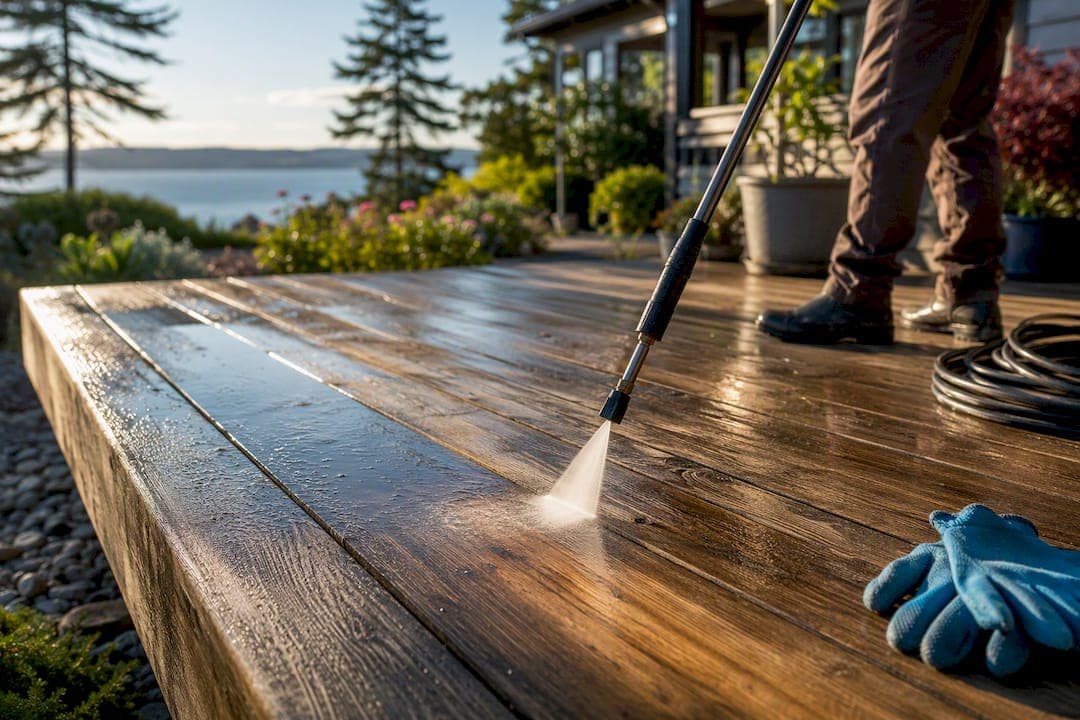
Yes, you can pressure wash most decks yourself, and it works well when you match your PSI, nozzle, and technique to your deck's material. The safest path: clear the deck fully, use a wide-fan nozzle at low pressure, wash with the grain, and let everything dry completely before you stain or seal. Skip any of those steps and you risk gouged wood or a ruined composite surface.
TL;DR:
- Using a pressure washer with appropriate PSI and a wide-fan nozzle is essential to avoid damaging different deck materials, especially composite.
- Pre-wetting the deck, applying the right cleaner, and letting it dwell for several minutes are critical steps for effective and safe cleaning.
- Most damage occurs from holding the nozzle too close or for too long; constant movement and testing pressure prevent gouging and etching.
- Give the deck at least 48 hours to dry completely, checking moisture levels before staining to ensure proper adhesion and finish.
- Heavy moss buildup, complex shapes, or composite decks under warranty are better handled by professional cleaning services.
Table of Contents
- Deck cleaning pressure washing: tools and prep you need first
- The step-by-step deck power washing workflow
- Which cleaners work best for moss, algae, and grease?
- What PSI and nozzle should you use for your deck material?
- Safety checklist: avoiding the most common deck damage
- How long should a deck dry before staining?
- How often should you deep-clean your deck?
- What professionals do differently on deck cleaning jobs
- What the research actually supports
- When it makes sense to call in Islandmossbusters
- Sources
- FAQ
Deck cleaning pressure washing: tools and prep you need first
Before you touch the trigger, get your equipment right. An electric pressure washer suits most residential decks. It's lighter, quieter, and easier to control at low PSI than a gas unit, which tends to deliver more power than a wood deck needs. If your machine has a detergent-feed tank or downstream injector, use it. That lets you apply cleaner at low pressure through the same wand, which is safer than switching nozzles mid-job.
Bring the right tips. A 25° to 40° fan nozzle is your workhorse for both wood and composite decking. Never use a zero-degree or turbo nozzle on decking. Those tips concentrate water into a pinpoint stream that can carve grooves into wood or blast pits into composite in seconds.
Before you start washing, work through this prep list:
- Clear all furniture, planters, rugs, and toys off the deck surface.
- Sweep debris and scrape leaves, needles, and dirt out of board gaps with a putty knife or gap tool.
- Check for loose boards, popped nails, or soft spots and repair them before applying water.
- Cover nearby electrical outlets and light fixtures, and shut off power to any deck-mounted receptacles.
- Wet down or tarp garden beds and shrubs bordering the deck to limit detergent contact.
- Put on eye protection, closed-toe boots with good grip, and gloves rated for the cleaner you're using.
That last step matters more than most people think. Wet decking gets slippery fast, and a pressure washer wand kicks back with real force at close range.
The step-by-step deck power washing workflow
Once the deck is clear and protected, work through the wash in order. Rushing the sequence, especially skipping the pre-soak or drying the cleaner on the surface, is where most DIY jobs go wrong.
- Pre-wet the deck with plain water from a hose or your washer on the lowest pressure setting. This stops cleaner from soaking too fast into dry, thirsty wood.
- Apply cleaner or stripper through your detergent nozzle or a pump sprayer, working in manageable sections rather than the whole deck at once.
- Let it dwell. Most deck cleaners need a few minutes of contact time to break down mould, algae, and grey weathering. A full stepwise workflow calls for applying a stripper or cleaner, letting it sit, then rinsing with a 25° to 30° tip at 8 to 12 inches from the surface. Never let cleaner dry on the boards. It can streak or bleach unevenly if it bakes in the sun.
- Make your low-pressure pass. Hold the wand at a consistent distance from the surface, keep it moving in smooth, overlapping strokes, and always work with the grain of the wood, not across it.
- Spot-treat stubborn stains with a second pass or a stiff-bristle deck brush rather than cranking up the pressure. Increasing PSI to fight a stain is exactly how people gouge boards.
- Rinse everything down, including nearby siding, railings, and any plants that got overspray, to flush away cleaner residue before it dries.
- Inspect the surface while it's still wet. Look for raised grain, fuzzy fibres, or lingering discolouration so you know whether a light sanding or a second cleaning pass is needed.
Keep the nozzle moving the entire time you're spraying. Holding it still on one spot, even at a modest PSI, is how a low-pressure job turns into an accidental etching job.
Pro Tip: Test your pressure and distance on an inconspicuous corner or a scrap board first. Thirty seconds of testing saves you from an obvious pale patch in the middle of your deck.
Which cleaners work best for moss, algae, and grease?
The right cleaner depends on what you're fighting and what your deck is made of. Green or black staining usually means algae or mould; a fuzzy, cushiony patch is moss; a grey, weathered look is UV oxidation rather than biological growth, and it needs a brightener, not a disinfectant.
- For algae and mould, an oxygenated deck cleaner or a diluted bleach solution breaks down organic growth without the fibre damage that harsh alkaline strippers can cause.
- For moss, a mix using diluted bleach or a vinegar and dish soap combination lifts growth loose enough for a low-pressure rinse to carry it away.
- For grease or barbecue stains, a citrus-based degreaser applied with a stiff brush handles the spot before you bring in the washer.
- For grey, weathered wood headed for restaining, a wood brightener restores the natural tone and opens the grain so stain absorbs evenly.
Whatever you mix, protect the landscaping first. Bleach and strong detergents are hard on grass, shrubs, and perennials, so soak nearby plants with plain water before and after applying cleaner, and never let runoff pool at the base of anything you want to keep alive. If your deck is composite, check the manufacturer's list of approved cleaners before reaching for bleach. Some composite formulations react badly to strong alkalis and can discolour permanently.
What PSI and nozzle should you use for your deck material?
Every deck material has its own tolerance, and this is where most damage happens. Composite decking, in particular, is far less forgiving than wood.
- Softwoods (cedar, pine): Stay in the 500 to 1,200 PSI range with a wide fan tip, keeping the nozzle 8 to 18 inches from the surface depending on pressure and board condition, since softwood tolerates far less force than concrete or masonry.
- Pressure-treated lumber and hardwoods: These can generally handle 1,000 to 1,500 PSI with a wide fan nozzle, though you should still start low and increase only if the surface isn't responding.
- Composite decking: Treat your washer as a rinsing tool, not a scrubbing one. TimberTech caps pressure at 1,500 PSI for its products and requires a fan tip, and other manufacturers set limits just as strict, since composite surfaces scar permanently under a zero-degree or turbo nozzle.
- Very old pressure-treated lumber: Decks built before 2004 may contain chromated copper arsenate. Skip aggressive chemical strippers on this older lumber and call a professional if you're unsure what you're working with.
Whatever the material, wood cleaning generally allows more pressure than composite, which needs gentler settings to avoid surface damage. When in doubt, start at the bottom of the range and work up.
Safety checklist: avoiding the most common deck damage
Most deck damage isn't from bad luck. It's from a nozzle held too close, too long, in the wrong spot.
- Keep kids, pets, and bystanders off the deck and out of spray range while you work.
- Cover or de-energize nearby electrical outlets, and never spray directly at light fixtures or switches.
- Keep the wand moving at all times, and hold your tested distance rather than drifting closer to "help" a stubborn stain.
- Watch for scoring, fuzzy raised grain, or splintering as you go. If you see it, stop, back off the pressure, and switch to hand scrubbing that section.
- Call a professional if you find widespread rot, soft or sagging boards, or if your composite decking is still under manufacturer warranty, since improper cleaning can void it.
Pro Tip: If a board feels soft or spongy underfoot before you even start, that's a structural issue, not a cleaning issue. Pressure washing won't fix rot, and it can make hidden damage worse.
How long should a deck dry before staining?
Give it at least 24 to 72 hours, and treat 48 hours as your baseline in average weather. Shaded decks, cool temperatures, or humid coastal air can push that timeline out further, since experts point to trapped water in the wood fibres as the real risk, not just a damp-looking surface.

A simple check: press a paper towel against the boards. If it comes away damp, wait longer. For a more reliable read, a moisture meter reading under 15% is the general benchmark before stain will bond properly. If washing raised the wood grain or left old, flaking stain behind, a light sanding once it's fully dry gives new stain something even to grip. Composite boards don't need this step. Once rinsed and dry to the touch, they're ready, though it's still worth checking your manufacturer's specific guidance on stain lifespan if you're finishing any wood accents nearby.

How often should you deep-clean your deck?
Once or twice a year covers most climates: a spring wash to undo winter grime, and a fall wash before the wet season sets in. Shaded, coastal, or heavily treed properties often need the higher end of that range, since damp, shielded spots regrow moss and algae faster.
- Sweep regularly and clear debris from board gaps between deep cleans.
- Trim back overhanging branches to let more sun and airflow reach the surface.
- Improve drainage under and around the deck if water tends to pool.
If moss keeps returning within weeks of a wash, that's usually a drainage or shade problem, not a cleaning-frequency problem, since debris trapped in the gaps feeds the regrowth cycle no matter how often you wash.
What professionals do differently on deck cleaning jobs
Pros lean on lower pressure and longer dwell times, not more force, because a cleaner doing the work beats a nozzle doing it. That's also why bundling a deck wash with a house wash or gutter cleaning often lowers the effective per-job cost, since most crews carry a fixed visit minimum regardless of how small the job is.
Professional exterior cleaning crews often use eco-conscious cleaning solutions and stick to a low-pressure, safety-first approach on every surface they clean, decks included. The mistake we see most often in the field is homeowners chasing a stain with higher pressure instead of a longer soak. A better dwell time fixes it without touching the wood.
What the research actually supports
The conventional advice on this topic gets one thing badly wrong: it treats "pressure washing a deck" as a single, universal technique. It isn't. A cedar deck and a composite deck are entirely different materials with entirely different failure points, and most of the horror stories you'll find online (etched wood, blotchy composite, voided warranties) trace back to someone applying wood-deck confidence to a composite board, or vice versa.
What the evidence actually supports is a boring but effective priority order: identify your material first, then match PSI and nozzle to it, then worry about technique. Skip that sequence and no amount of careful wand work saves you. The other underrated factor is patience. Dwell time on the cleaner and dry time before staining both get rushed constantly, and both are where DIY jobs quietly fail weeks later rather than in the moment. If you take one thing from this guide, take this: slow down on the chemistry and the drying, and the pressure part becomes almost easy.
— Island
When it makes sense to call in Islandmossbusters
Islandmossbusters is the practical alternative when a deck job outgrows a weekend DIY project in the Comox Valley and across Vancouver Island. If you're dealing with heavy moss buildup, persistent odour, a multi-level deck, or composite boards still under warranty, the risk of getting PSI or nozzle choice wrong outweighs the savings of doing it yourself.

Booking a professional service typically means insured crews, eco-friendly cleaning solutions, and a clear quote before any work starts. We often pair deck cleaning with a full house washing visit or pressure washing for driveways and walkways, which spreads out the visit cost and gets your whole exterior looking cared for at once. If moss is spreading from your roofline down onto the deck below, our roof cleaning and moss removal service tackles the source rather than just the symptom. Request a quote or inspection today, and we'll tell you honestly whether your deck is a DIY job or one worth handing off.
Sources
FAQ
Is it a good idea to pressure wash a deck?
Yes, for most wood and composite decks, as long as you match PSI and nozzle to the material and never use a zero-degree or turbo tip. It's the fastest way to lift years of grime, moss, and grey weathering without harsh scrubbing.
What's the average cost to power wash a deck?
Standalone deck cleaning typically runs $150 to $350, though bundling it with a house wash or gutter cleaning often lowers the effective cost per job. Islandmossbusters provides a clear quote before starting any pressure washing work.
What do you put on a deck before pressure washing?
Apply a deck cleaner or stripper suited to your material and let it dwell for several minutes before rinsing, rather than spraying plain water straight onto years of buildup. Pre-wetting the boards first helps the cleaner spread evenly instead of soaking in unevenly on dry wood.
What is the best way to clean decking with a pressure washer?
Use a wide fan nozzle (25° to 40°), keep the wand moving at a consistent 8 to 18 inch distance, and always work with the grain rather than across it. Start at the low end of your material's safe PSI range and increase only if the surface isn't responding.
How long should I wait to stain my deck after washing it?
Wait at least 24 to 72 hours, with 48 hours as a solid baseline in average conditions and longer in shade or cool, humid weather. A moisture meter reading under 15% is a reliable sign the wood is dry enough for stain to bond properly.